RSS Google AI Blog
Follow
A colorful quantum future
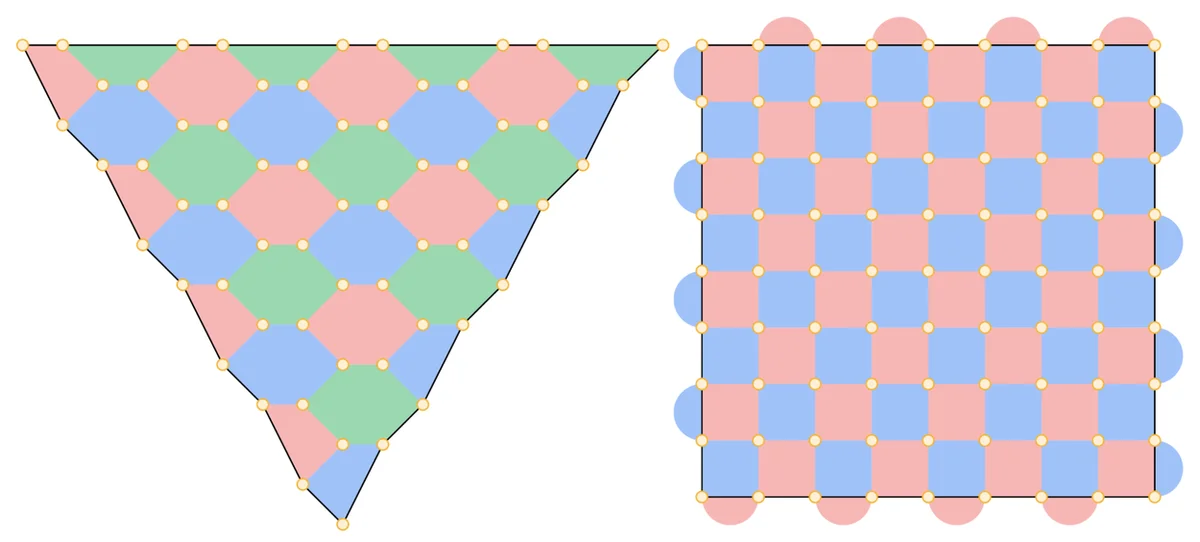
Error correction is crucial for large-scale quantum computers, and it involves combining physical qubits to create a logical qubit that's more robust to noise. Recently, a surface code quantum error correction experiment exceeded the performance threshold, allowing for the creation of a near-perfect logical qubit by adding more physical qubits. To further improve error correction, researchers are exploring ways to minimize the number of physical qubits per logical qubit and maximize the speed of logical operations. One approach is to improve the quality of physical qubits, while another is to make the error correction code more efficient. A new experiment has demonstrated a "color code" system, which provides an alternative to the surface code and requires fewer physical qubits and boasts more efficient logical gates. The color code uses a triangular pattern of parity measurement, which is more efficient than the surface code's square pattern. However, the color code requires deeper physical circuits and a different decoding algorithm, making it more challenging to implement. Despite this, the experiment showed that the color code can achieve below-threshold performance, and its geometrical advantage may become more significant at larger scales. The color code also enables faster single-qubit logical operations and can be used to generate "magic states" required for arbitrary qubit rotations. Overall, the color code is a promising alternative to the surface code and may become a key component of large-scale quantum computers.