RSS Google AI Blog
Follow
A verifiable quantum advantage
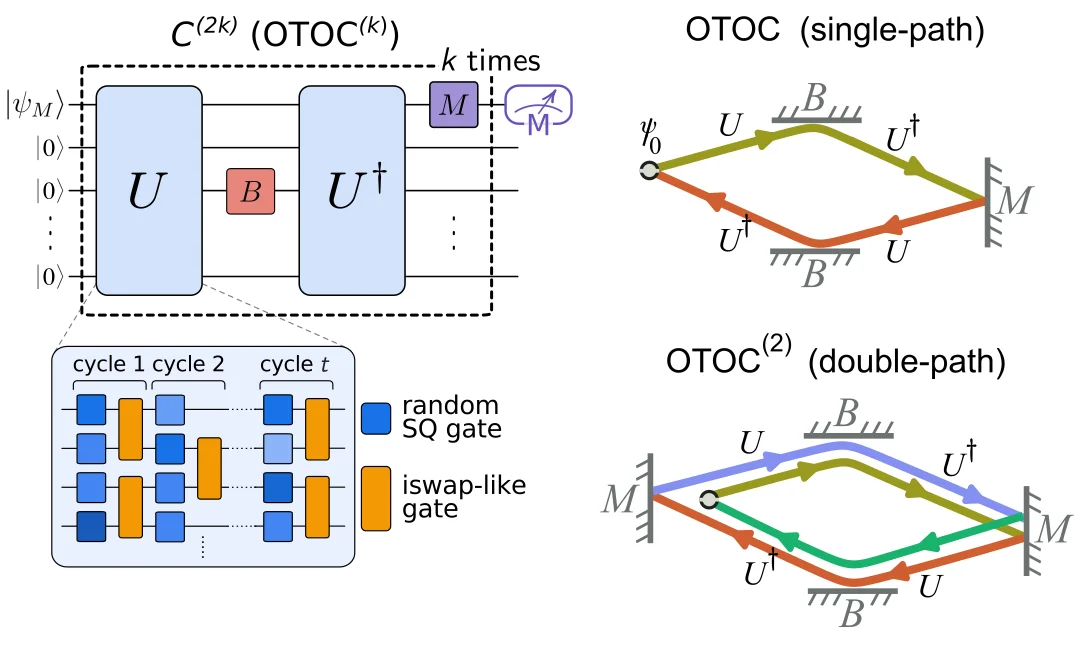
The text discusses quantum chaos and its simulation using quantum computers, focusing on a new algorithm called Quantum Echoes. Quantum Echoes utilizes the out-of-time-order correlator (OTOC) to measure quantum dynamics and identify chaotic behavior. Unlike previous methods, OTOCs produce verifiable computational outcomes applicable to real-world problems. The Quantum Echoes algorithm, tested on the Willow quantum chip, demonstrates a beyond-classical regime for specific quantum circuits. Higher-order OTOCs reveal complex quantum interference effects, similar to interferometers, enhancing quantum signals. This interference results in a computational gap between quantum and classical processors, confirmed through theoretical analysis and experiments. The study identifies obstacles for classical algorithms in simulating quantum interference, making the OTOC calculations on Willow significantly more efficient. As a practical application, the authors propose Hamiltonian learning, using OTOCs to enhance the understanding of physical systems. Preliminary experiments simulating molecular structures using nuclear magnetic resonance (NMR) spectroscopy showcase the potential for real-world applications. The approach, though not yet beyond classical, shows promise for improving models of molecular structure.