RSS Google AI Blog
Follow
Designing synthetic datasets for the real world: Mechanism design and reasoning from first principles
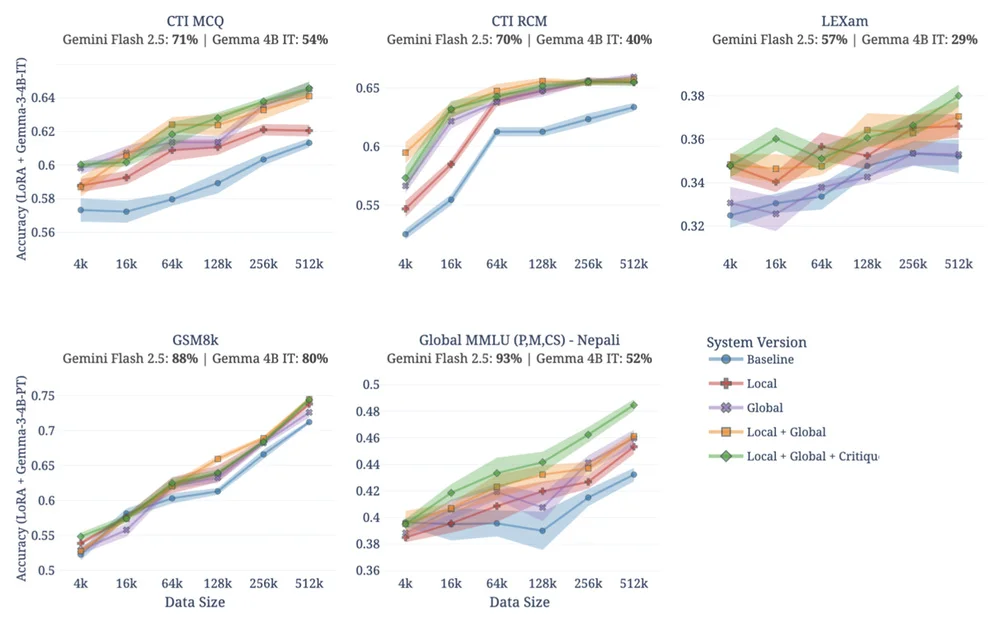
The paper addresses the challenge of creating specialized AI models by generating synthetic data, crucial where real-world data is scarce or inaccessible. Simula, the proposed framework, reframes synthetic data generation as a mechanism design problem prioritizing control. Simula's "reasoning-first" approach builds datasets from first principles, ensuring global diversification through hierarchical taxonomies. Local diversification, using meta-prompts, ensures variety within concepts and prevents mode collapse. The framework also incorporates complexification to adjust difficulty and quality checks to verify correctness. The Simula system consistently outperforms simpler baselines in experiments across diverse domains, like cybersecurity and legal reasoning. Evaluation utilizes reasoning-based metrics like taxonomic coverage and calibrated complexity scoring. The findings emphasize that data must be tailored to the model's capabilities, with data quality being more critical than mere volume. Simula serves as a data engine for Google, enabling specialized models and user protection features. Furthermore, Simula enables research on synthesizing realistic attack scenarios and teaching AI to read maps. Synthetic data is pivotal for future AI advancements, and Simula demonstrates the potential of controlling data generation.