RSS Google AI Blog
Follow
Graph foundation models for relational data
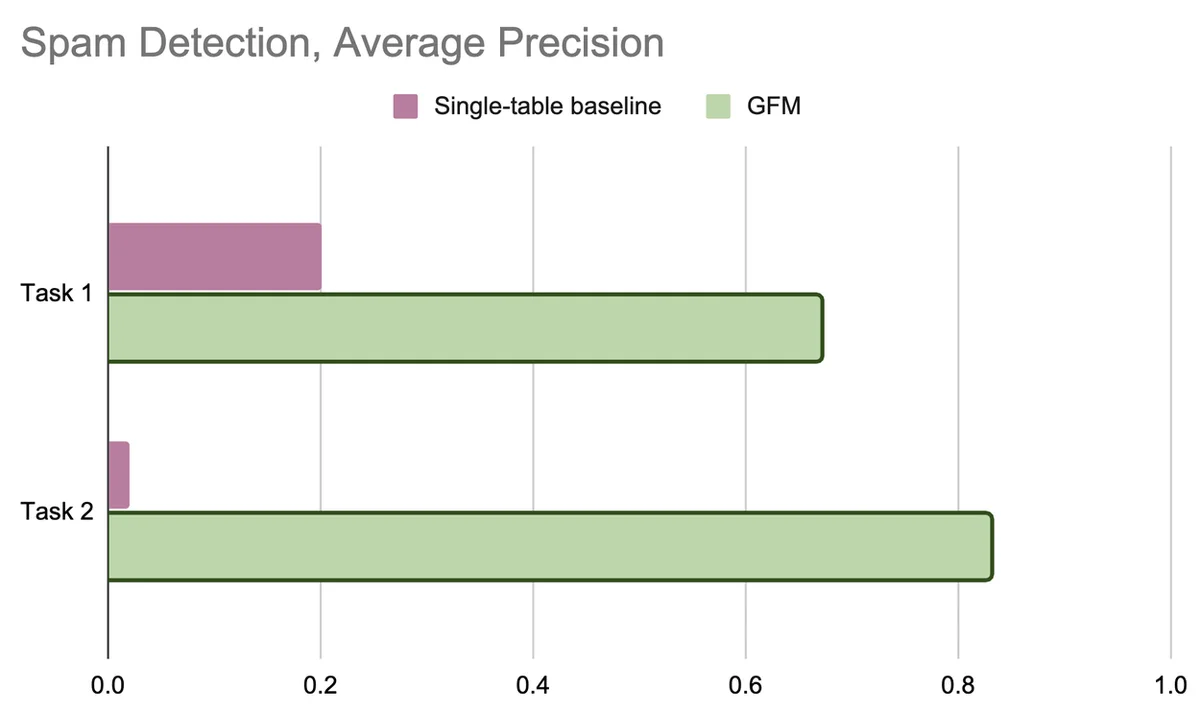
Relational databases are widely used in enterprise data formats and power many prediction services, but traditional machine learning methods struggle to fully leverage the connectivity structure of these relational schemas. Graph neural networks (GNNs) are well-suited for graph-structured data, but most GNNs are fixed to a particular graph and cannot generalize to novel graphs with new nodes, edge types, features, and node labels. The goal is to design a single model that can excel on interconnected relational tables and generalize to any arbitrary set of tables, features, and tasks without additional training. This can be achieved by transforming relational tables into a single heterogeneous graph, where each table becomes a unique node type and each row in a table becomes a node. A graph foundation model (GFM) can be trained on one graph and perform inference on any unseen graph despite the differences in structure and schema. The key challenge is to create a transferable method for encoding arbitrary database schemas and handling node features. The results show that GFMs can bring significant performance boosts compared to traditional tabular baselines, and leveraging the structure of data can improve ML models with broad applications in artificial intelligence.