Kubernetes Blog
Follow
Kubernetes v1.36: PSI Metrics for Kubernetes Graduates to GA
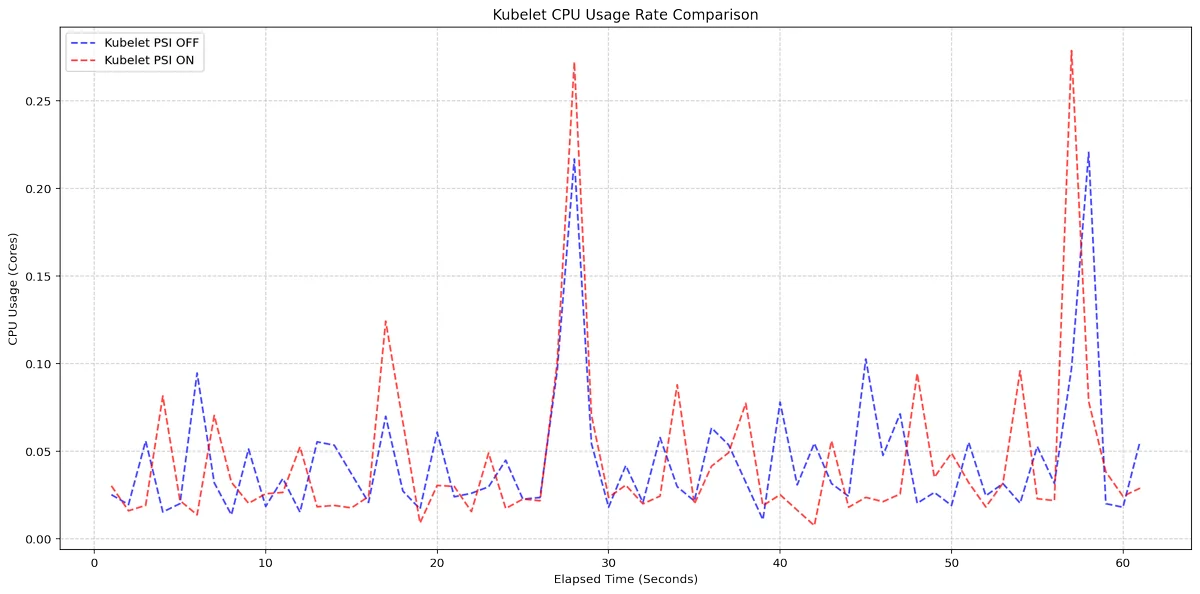
Pressure Stall Information (PSI) has been integrated into the Linux kernel since 2018, providing high-fidelity signals for identifying resource saturation before it leads to outages. Unlike traditional utilization metrics, PSI quantifies stalled tasks and lost time across CPU, memory, and I/O. With Kubernetes v1.36, a stable interface for observing resource contention at node, pod, and container levels is now available. PSI offers cumulative totals of stalled time and moving averages (10s, 60s, 300s) to distinguish between transient spikes and sustained resource tension.Extensive performance testing by SIG Node on high-density workloads (80+ pods) proved PSI's readiness for production. Kubelet overhead, measured by toggling the KubeletPSI feature gate, showed negligible impact on resource usage. The Kubelet's collection logic proved lightweight, blending seamlessly into standard housekeeping cycles, consuming less than 0.1 cores or 2.5% of total node capacity.Regarding kernel overhead, enabling PSI on the Linux kernel (psi=1 vs psi=0) resulted in a consistent delta of 0.037 to 0.125 cores (0.925% - 3.125% of node capacity) under heavy load. The kubelet process, as the primary collector, also maintained remarkably low CPU usage, with spikes not exceeding 0.25 cores (6.25%) for more than a second.Improvements in v1.36 include smarter metric emission; the Kubelet now detects OS-level PSI support via cgroup configurations before reporting, preventing misleading zero-valued metrics. To use PSI, nodes must run Linux kernel 4.20+, use cgroup v2, and have PSI enabled at the OS level (CONFIG_PSI=y, no psi=0 boot parameter).PSI metrics are generally available in v1.36 and require no feature gate opt-in. Users can scrape the /metrics/cadvisor endpoint or query the Summary API. PSI is a Linux-kernel feature and is not available on Windows nodes. Proxying to the Kubelet's HTTP API via the control plane's API server allows real-time pressure data from the Summary API but is a privileged operation.