RSS Google AI Blog
Follow
Optimizing LLM-based trip planning
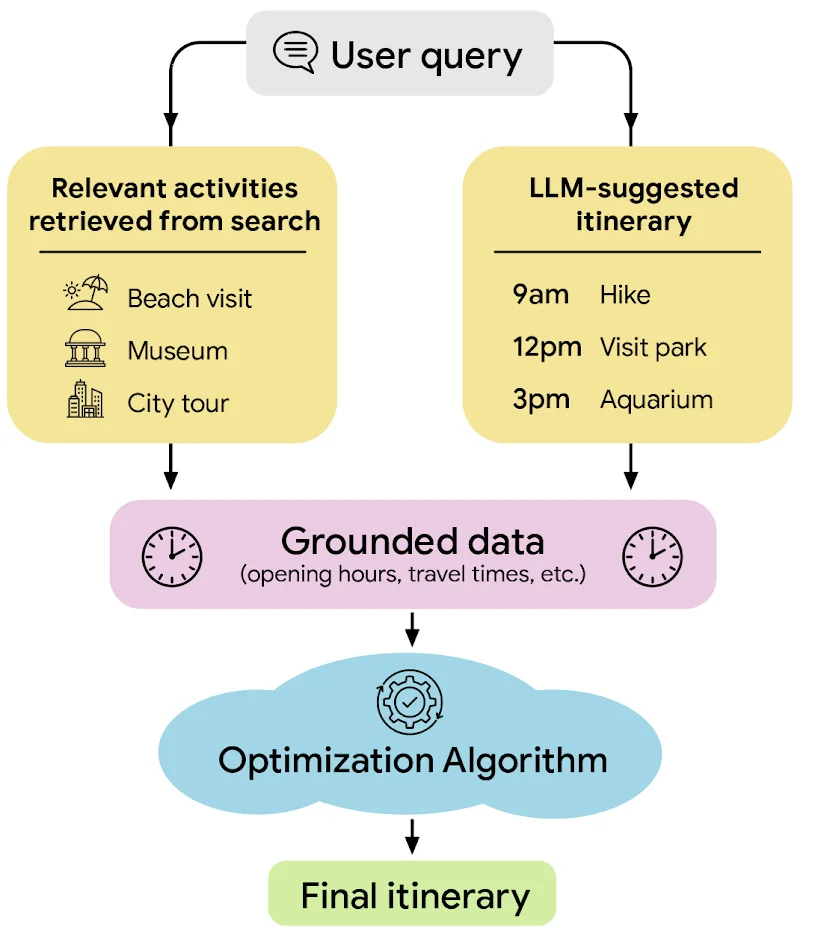
Planning tasks often involve both quantitative constraints and qualitative objectives, and large language models (LLMs) are good at handling qualitative aspects but struggle with quantitative logistical constraints. To overcome this, a hybrid system was developed that uses an LLM to suggest an initial plan and then optimizes for similarity to the LLM and real-world factors like travel time and opening hours. The system takes a user query, passes it to an LLM, and then adds components to address feasibility issues, including grounding the itinerary with real-world data and retrieving substitute activities. The optimization algorithm has two stages, first determining optimal scheduling for each day and then searching for an overall itinerary that maximizes the total score. The algorithm makes local adjustments to the initial itinerary to increase the total score, resulting in a final itinerary. The system was tested with queries, such as planning a trip to NYC visiting lesser-known museums, and was able to produce a more suitable itinerary than relying solely on search-retrieved activities. The system also corrected issues with the original LLM-suggested itinerary, such as scheduling activities in an unnatural way. The work has implications for other everyday tasks, such as organizing an event or scheduling errands, and is part of a larger effort to develop systems that allow LLMs to navigate real-world constraints. The system was developed in collaboration with several individuals and received helpful guidance from others.