InfoQ

INFOQ is a technology-focused media company that aims to share emerging technology insights and innovative practices in software engineering, including AI, Data Science, and more. The site offers articles, videos, and interviews with leaders in the tech industry.


Thread Of Notes

AI Agent Identity and Permission Challenges: How Uber and Auth0 Are Rethinking Access Control

Uber recently described an internal architecture for propagating identity across multi-agent AI workflows. The design aims to perserve user context, agent provenance, and scoped access as agents delegate work and call internal tools. The case study aligns with Auth0’s view that AI agents need permissions based on delegated authority, scoped credentials, and explicit human approval boundaries. By Eran Stiller
CdXz5zHNQW_vWWCclrPn7.jpeg

Presentation: From Hype to Strong Foundations: What the Rise, Fall and Resurgence of Agents Can Teach Us About Outlasting the Cycle

Aditya Kumarakrishnan explains how to move past the "amnesia phase" of AI. He shares a blueprint for engineering leaders to build modular agent frameworks using CoALA, leverage decades of process science for scalable workflows, and "terraform" legacy environments into robust, event-sourced artifacts capable of handling unpredictable, cross-functional agent demands. By Aditya Kumarakrishnan
CdXz5zHNQW_BdT3ji6ZN1.jpeg

GitHub Copilot Desktop App Targets Parallel Agentic Workflows

GitHub has introduced the GitHub Copilot app, a desktop control centre for agent-native development that aims to keep engineers in charge while AI agents handle more coding work. Mario Rodriguez writes on the GitHub blog that the recent wave of coding agents has brought faster delivery but also "disjointed workflows, more context switching, and too much time spent reviewing agent-generated code". By Matt Saunders
CdXz5zHNQW_SmomDk15wm.jpeg

Presentation: Automating the Web With MCP: Infra That Doesn’t Break

Paul Klein discusses the distributed systems challenges of scaling cloud-hosted browser infra for AI agents. He explains how to manage bursty, stateful multi-tenancy and secure Chromium environments against remote code execution using Firecracker. He also shares how to leverage the Model Context Protocol (MCP) to turn complex websites into accessible agentic tools. By Paul Klein
CdXz5zHNQW_gGbqBl7yKX.jpeg

Coinbase Postmortem Reveals How a Localized AWS Failure Triggered a Multi-Hour Trading Outage

Coinbase has published a detailed postmortem of its May 7, 2026, outage, revealing how a localized cooling failure inside an AWS data center escalated into a multi-hour disruption that halted nearly all trading activity across the cryptocurrency exchange By Craig Risi
CdXz5zHNQW_jsnM3jP2K8.jpeg

AI Coding Agents Get a Stack Overflow of Their Own

Stack Overflow has announced Stack Overflow for Agents, a beta API-first knowledge exchange aimed at AI coding agents rather than human developers. The service is presented as a way to close what the company calls the Ephemeral Intelligence Gap, where agents repeatedly rediscover the same fixes and patterns in isolation instead of sharing them through a common memory. By Matt Saunders

CdXz5zHNQW_tz12lVuIq3.jpeg

PostgreSQL 19 Beta Introduces SQL Graph Queries and Concurrent Table Repacking

PostgreSQL 19 Beta has been announced, with general availability expected in September, following the project's yearly major-release cadence. This release introduces native SQL Property Graph Queries (SQL/PGQ), concurrent table repacking to reclaim storage without downtime, and a broad set of performance, observability, and administration improvements. By Renato Losio
CdXz5zHNQW_RckWLy8gtw.jpeg

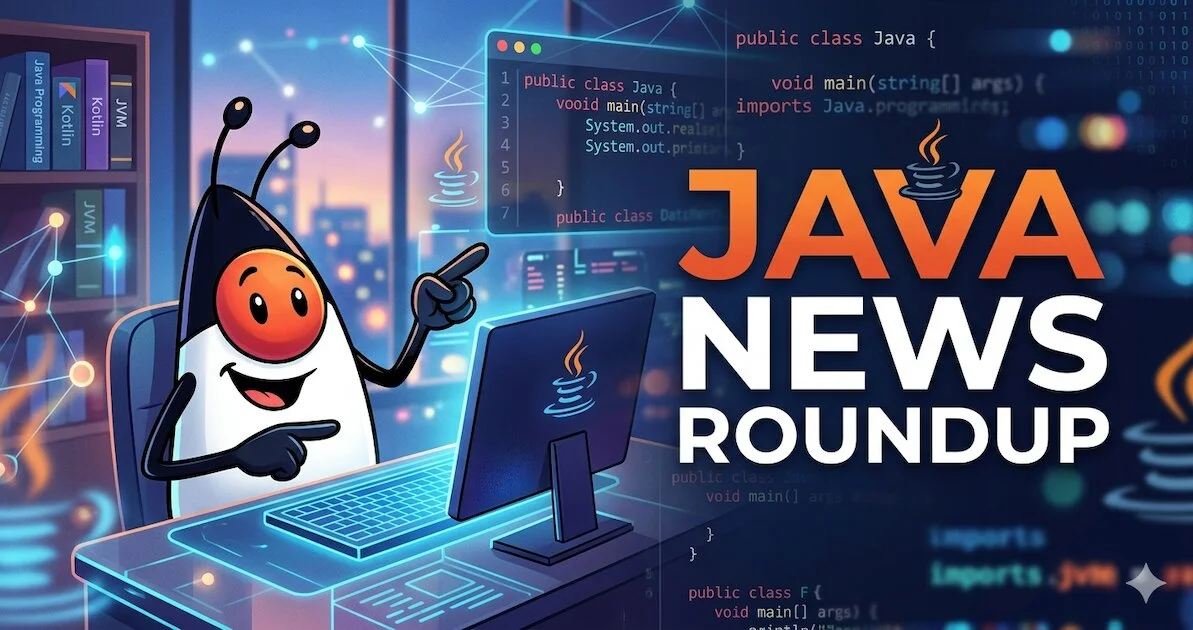
Java News Roundup: A2A Java SDK 1.0, Jakarta EE 12, JNoSQL, GraalVM, Micrometer, OpenXava, Gradle

This week's Java roundup for June 8th, 2026, features news highlighting: the GA release of A2A Java SDK 1.0; an update on Jakarta EE 12; point releases of Micrometer Metrics and Micrometer Tracing; maintenance releases of GraalVM Native Build Tools and OpenXava; the second release candidate of Gradle 9.6; and the first milestone release of Eclipse JNoSQL 1.2. By Michael Redlich
CdXz5zHNQW_9jaKRpBCJ0.jpeg

Xcode 27 Extends Agent Integration, Revamps UI, and Introduces DeviceHub

At WWDC 2026, Apple introduced Xcode 27, which makes it easy to kick off tasks with coding agents, iterate on new project ideas, and customize the workspace. It also introduces DeviceHub for unified simulator and device management, along with enhancements to Organizer and Instruments, among many other improvements. By Sergio De Simone
CdXz5zHNQW_OZqbofcan4.jpeg

Anthropic Explains How Claude Builds Its Own Execution Harnesses

Anthropic has published additional details about the orchestration system behind Claude Code's recently introduced Dynamic Workflows, highlighting how the feature generates custom execution harnesses designed to coordinate teams of AI agents for complex tasks. By Robert Krzaczyński
CdXz5zHNQW_d8WdIRcoNx.jpeg

Spring News Roundup: Point Releases of Boot, Security, Integration, Modulith and Spring AI 2.0

There was a flurry of activity in the Spring ecosystem during the week of June 8th, 2026, highlighting point releases of: Spring Boot, Spring Security, Spring Session, Spring Integration, Spring Modulith, Spring AMQP and Spring Vault; and GA releases of Spring AI 2.0 and Spring Data 2026.0.0. By Michael Redlich
CdXz5zHNQW_QYKNvVi5Yq.jpeg

Presentation: Practical Performance Tuning for Serverless Java on AWS

AWS Hero Vadym Kazulkin explains how to overcome Java’s enterprise hurdle on AWS Lambda: cold starts and memory footprints. He shares a technical deep dive into performance tuning, comparing fully managed AWS SnapStart (with pre-snapshot priming hooks) against GraalVM ahead-of-time compilation, while addressing the latest architectural implications of Project Leyden and Java 25. By Vadym Kazulkin
CdXz5zHNQW_TG4k1L705C.jpeg

ArrowJS Reaches 1.0, Recast as the First UI Framework for the Agentic Era

ArrowJS, developed by Justin Schroeder, is a reactive UI library that has reached its 1.0 release after three years in development. It utilizes core web technologies, avoids JSX and compilers. Notable features include an optional WASM sandbox for executing untrusted code. The framework's minimalism is highlighted by its reliance on three main functions: reactive, html, and component. By Daniel Curtis
CdXz5zHNQW_QN4B1k67p0.jpeg

Podcast: Increasing Users' Data Agency: From BlueSky's AT Protocol to the Local-First Software Movement

Martin Kleppmann, an associate professor at Cambridge and author of Designing Data-Intensive Applications, discusses the evolution of data systems over the last decade, mainly the shift from monolithic databases to modular building blocks. Kleppmann underlines the importance of moving from cloud-centric data storage systems to decentralised data storage similar to Bluesky’s AT protocol. By Martin Kleppmann
CdXz5zHNQW_ieJGNJGNrW.jpeg

Article: Governing AI in the Cloud: A Practical Guide for Architects

In this article, the author outlines a practical approach to AI governance in the cloud, covering discovery of shadow AI, data classification at creation, IAM-based enforcement, policy-as-code, and operational controls. The article shows how organizations can embed governance into delivery pipelines, balancing security, compliance, and developer productivity without relying on manual processes. By Dave Ward
CdXz5zHNQW_HZ181AB7NB.jpeg

Anthropic Releases and Temporarily Suspends Claude Fable 5

On June 9, 2026, Anthropic launched Claude Fable 5, a model designed for long-horizon tasks, but it was taken offline shortly after due to a U.S. government export directive. It shares architecture with Claude Mythos 5, supporting extensive token usage. The model includes mandatory data retention requirements, which have affected its deployment with partners like Microsoft. By Andrew Hoblitzell
CdXz5zHNQW_Hq9QjiScfk.jpeg

Spring Boot 4.1 Adds gRPC Auto-Configuration, SSRF Mitigation, and Kotlin 2.3 Support

Broadcom released Spring Boot 4.1 on June 10, 2026, to deliver gRPC auto-configuration, HTTP-client SSRF mitigation, and upgrades to Kotlin 2.3. It also brings lazy datasource connections, async context propagation for @Async methods, and improved OpenTelemetry support. Uncharacteristically, Broadcom moved the releases twice, first from May 11-22 to June 1-5, then to June 8-12. By Karsten Silz
CdXz5zHNQW_CCWJ3fezgq.jpeg

Vercel Labs Open-Sources Zero-Native: A Zig-Based Cross-Platform Native Application Framework

Vercel Labs recently open-sourced zero-native, a cross-platform framework for native desktop applications. Zero-native bypasses Electron runtime in favor or native OS WebViews and claims to achieve smaller, more efficient native apps with minimal overhead. Zero-native is written in Zig, thus directly interoperates with native C libraries, and features fast incremental compilation times. By Bruno Couriol
CdXz5zHNQW_NGKu68D0IQ.jpeg

AWS Introduces Durable Storage Option for ElastiCache for Valkey

AWS has recently introduced durability for Amazon ElastiCache for Valkey, enabling reliable data retention across failures and expanding support beyond caching to persistent workloads. The feature offers new options that prioritize either minimizing data loss or maintaining lower write latency, expanding the range of use cases supported by the Redis fork. By Renato Losio
CdXz5zHNQW_80zCWxmCU2.jpeg

Terraform MCP Server Enables AI Assistants to Interact with Terraform Infrastructure

HashiCorp has announced the general availability of the Terraform MCP Server, an open-source MCP server that enables agents to integrate with Terraform Registry APIs. The company says that it can improve infrastructure teams productivity by relieving engineers of rote tasks. By Sergio De Simone
CdXz5zHNQW_ZqpuuCOajo.jpeg

AWS Introduces CDK Mixins for Composable Infrastructure Abstractions

AWS recently announced CDK Mixins, a new AWS CDK feature that lets developers add reusable capabilities like security, monitoring, and configuration to AWS resources. Mixins work across different construct types, making infrastructure code more flexible and reusable. By Renato Losio
CdXz5zHNQW_xrTLzMs1Ir.jpeg

WebMCP Standard Proposal for Agentic Web Actuation Now Available in Chrome (Origin Trials)

Google recently announced that WebMCP is entering origin trials in Chrome 149. The new WebMCP standard proposal lets sites expose tools (e.g., JavaScript functions and HTML forms) to in-browser AI agents, which can thus reliably simulate user actions instead of resorting to possibly expensive (e.g., on-screen reading) and often unreliable guesswork (e.g., DOM scraping). By Bruno Couriol
CdXz5zHNQW_2gcbaDUN21.jpeg

Slack Eliminates SSH in EMR Pipelines, Migrates 700+ Jobs to Rest-Based Architecture

Slack modernized its data platform by replacing SSH based execution in Amazon EMR pipelines with a REST driven orchestration layer called Quarry. The migration covered 700 plus Airflow operators, improving security, reliability, and observability while eliminating direct SSH access across production clusters and enabling a server side job lifecycle model. By Leela Kumili


CdXz5zHNQW_NUMwwxn0JV.jpeg

Angular's Official Agent Skills Helps AI Coding Tools Write Modern Angular

Google's Angular team has released a repository called angular/skills, focusing on Agent Skills that enhance AI coding agents' ability to write modern Angular code. The repository includes skills for generating code and scaffolding applications, reinforcing current Angular conventions. It serves as a snapshot, aiming to improve AI suggestions by providing updated context. By Daniel Curtis
CdXz5zHNQW_pb35ViaZmh.jpeg

Run Untrusted AI Agent Code Safely with Azure Container Apps Sandboxes

Microsoft has announced the public preview of Azure Container Apps Sandboxes. This new ARM resource type is Microsoft.App/SandboxGroups, runs untrusted code generated by agents in hardware-isolated environments. Each sandbox starts from an OCI disk image in less than a second. It can scale to thousands of instances at once and costs nothing when idle. By Claudio Masolo
CdXz5zHNQW_NXEBpvQw8H.jpeg

Presentation: Moving Mountains: Migrating Legacy Code in Weeks instead of Years

David Stein shares how to rethink large-scale architectural migrations using AI. He discusses ServiceTitan's "assembly line" pattern, explaining how decomposing legacy codebase refactoring into standardized tasks can achieve massive parallelization. He highlights the critical role of programmatically rigid validation loops to eliminate LLM hallucinations and accelerate engineering agility. By David Stein
CdXz5zHNQW_LlSAL83Zjt.jpeg

Podcast: Craig McLuckie on Culture as a Team's Operating System in the AI Era

In this podcast, Shane Hastie, Lead Editor for Culture & Methods spoke to Craig McLuckie, co-creator of Kubernetes and CEO of Stacklok, about the impact of AI coding tools on open source communities and engineering teams, designing deliberate organisational culture, and navigating evolving career paths for engineers in the age of AI. By Craig McLuckie
CdXz5zHNQW_bIQjG4whXL.jpeg

Oracle's OpenJDK Bans Generative AI Contributions While Oracle's GraalVM Allows Them

Two related, Oracle-backed projects published opposing policies on open-source contributions created with generative AI: The OpenJDK Governing Board approved an interim policy prohibiting such contributions, while the Coding Assistants policy from GraalVM permits them. Both projects require contributors to sign the same Oracle Contributor Agreement (OCA) for intellectual property. By Karsten Silz
CdXz5zHNQW_74hDe2ntJN.jpeg

Lyft Uses Mapping Intelligence to Reduce Friction in Gated Community Pickups

Lyft details a new pickup experience to improve reliability in gated communities, where 25–30% of rides face routing and access challenges. The system uses mapping signals, boundary detection, and routing improvements to reduce cancellations and coordination overhead between riders and drivers, highlighting how real-world constraints drive evolution in geospatial systems. By Leela Kumili
CdXz5zHNQW_XHon9TjqcC.jpeg

Building and Scaling a Platform with Project-as-a-Service

When a platform started with total developer autonomy, teams felt overwhelmed and ended up solving the same problems in completely different ways. The company shifted to enablement over support, working together with teams intensively, and helping teams feel confident and capable, turning the right way into being the easiest way. By Ben Linders
CdXz5zHNQW_7R8pXkgNZo.jpeg

OpenAI's GPT-5.5 and Codex Reach General Availability on Amazon Bedrock

OpenAI's GPT-5.5, GPT-5.4, and Codex are now generally available on Amazon Bedrock, one month after OpenAI revised its exclusive Azure arrangement. Pricing matches OpenAI's direct rates with usage counting toward AWS commitments. Codex shifts to pay-per-token billing with no seat fees. GPT-5.4 is the first OpenAI model available in AWS GovCloud. By Steef-Jan Wiggers
CdXz5zHNQW_uNt7UQSWRr.jpeg

Presentation: Building and Scaling UI Systems for Internal Tools at Meta

Cindy Zhang discusses the evolution of XDS, a unified UI system powering 10,000+ internal tools. She shares actionable insights for architects and engineering leaders on managing large-scale community contributions, executing safe monorepo refactors using JS AST and AI codemods, mitigating breaking changes via feature flags, and expanding UI libraries into full-stack platform systems. By Cindy Zhang
CdXz5zHNQW_CXicW0Jzoe.jpeg

Presentation: Beyond Prompting: Context Engineering and Memory Management for AI Systems at Scale

Adi Polak discusses the architecture required to transition from stateless prompts to state-aware, context-rich AI agents. Drawing on 15 years in distributed systems, she shares how engineering leaders can leverage Apache Kafka and Flink for real-time stream processing, dynamic memory tiering, and tool orchestration via MCP to solve token limits, cost spikes, and latency bottlenecks. By Adi Polak
CdXz5zHNQW_SBYJSmmEO4.jpeg

Azure API Management Ships Unified Model API and MCP Content Safety at Build 2026

Azure API Management shipped a Unified Model API that lets clients speak one format while APIM transforms requests to Anthropic, Vertex AI, and other backends. Content safety policies now cover MCP tool calls and Agent-to-Agent payloads alongside LLM traffic. Token metrics expanded to track reasoning, cached, and audio tokens across providers. By Steef-Jan Wiggers
CdXz5zHNQW_AArVGY8WVW.jpeg

Presentation: Confidently Automating Changes Across a Diverse Fleet

Netflix engineer Casey Bleifer shares how to achieve rapid, automated code changes across a massive, diverse software fleet. She discusses building an event-driven orchestration platform using composable, Lego-like steps, and explains how Netflix utilizes automated canary validation, compliance checks, and a custom "confidence metric" to eliminate the long tail of manual engineering migrations. By Casey Bleifer
CdXz5zHNQW_duRhADbBzo.jpeg

Microsoft Foundry Adds Runtime, Tooling, and Governance for Production Agents

Microsoft used their Build 2026 event to announce new functionality for Microsoft Foundry. Citing Foundry as "the place where AI agents move from experiments to production systems," in a blog post, Nick Brady writes that the release brings “runtime, tools, memory, grounding, models, observability, and governance” that developers need for production agents, rather than just new model endpoints. By Matt Saunders
CdXz5zHNQW_pPY43Mlvx4.jpeg

AWS Releases Next Generation of Amazon OpenSearch Serverless

Amazon Web Services has recently announced the general availability of the next generation of Amazon OpenSearch Serverless, with a redesigned architecture that enables 20 times faster resource provisioning than the previous serverless architecture, true scale-to-zero capability, and up to 60% lower cost than a provisioned cluster for peak loads. By Gianmarco Nalin
CdXz5zHNQW_qsYG4DrG6h.jpeg

Pinterest Uses Content Fingerprints for URL Deduplication Across Millions of Domains

Pinterest introduced MIQPS, a URL normalization system that identifies which query parameters affect page identity using rendered content fingerprints. It reduces duplicate processing across millions of domains by replacing rule-based approaches with offline analysis, anomaly detection, and runtime parameter maps, improving ingestion efficiency and scalability in large-scale content pipelines. By Leela Kumili
CdXz5zHNQW_S0Qgn0yiFk.jpeg

Java News Roundup: JDK 27 in Rampdown, JDK 28 Expert Group, GlassFish, Infinispan, Kotlin

This week's Java roundup for June 1st, 2026, features news highlighting: JDK 27 in Rampdown Phase One; the formation of the JDK 28 Expert Group; the GlassFish Arquillian Connectors Suite for Jakarta EE TCKs; point releases for Infinispan and Kotlin; maintenance releases of GlassFish and Micronaut; and the June 2026 beta release of Open Liberty. By Michael Redlich
CdXz5zHNQW_SCk61oogir.jpeg

Gemma 4 12B Enables On-Device, Multimodal Agentic Workflows with an Encoder-free Architecture

Google says Gemma 4 12B is "designed to bring agentic, multimodal intelligence directly to your laptop", further noting that the new model can be combined with Google AI Edge to "build and experiment locally, on everyday machines". This integration allows for a wide range of capabilities, from autonomous data processing to generating visual insights and even building webpages or executing tools. By Sergio De Simone
CdXz5zHNQW_tsiGvdtmx4.jpeg

Article: Artificial Intelligence-Driven Phishing: How Phishing Technique Is Evolving and Implemented

In this article, the author examines how AI is transforming phishing from a manual, targeted activity into an automated and scalable attack model. The article breaks down each stage of the phishing lifecycle, showing how AI improves reconnaissance, profiling, content generation, delivery, and interaction, while outlining layered defenses that combine controls, processes, and user awareness. By Marco Rizzi
CdXz5zHNQW_E28iG3sv5O.jpeg

Podcast: From MCP and Vibe Coding to Harness Engineering: How Did AI Native Engineering Evolve in One Year

Birgitta Böckeler, Distinguished Engineer at Thoughtworks, returns to discuss the rapid evolution of AI in software delivery. She touches on the evolution from vibe coding, the changing tools landscape and the more autonomous agents that, besides higher velocity, introduce higher risk. By Birgitta Böckeler
CdXz5zHNQW_mRbaPEUTRT.jpeg

Presentation: Mitigating Geopolitical Risks with Local-First Software and atproto

Martin Kleppmann discusses the urgent need for technological sovereignty in modern infrastructure. Exploring the shifting landscape of global tech dependencies, he shares how engineering leaders can leverage multi-cloud architecture, de facto API standardization, the AT Protocol, and local-first development paradigms to reclaim user agency and build highly resilient systems. By Martin Kleppmann
CdXz5zHNQW_q3IvzjrMeP.jpeg

Presentation: Beyond Speed Limits: Exploring the Performance Power of Valkey

Senior Solution Architect Viktor Vedmich shares how engineering leaders can maximize application performance using Valkey. He discusses the open-source Redis fork's 100% API compatibility, explores advanced caching strategies like lazy loading, and explains how to implement powerful data structures for real-time analytics, rate limiting, and session stores to solve the thundering herd problem. By Viktor Vedmich
CdXz5zHNQW_xTk8manV4J.jpeg

Microsoft Discovery Reaches GA on Azure, Powering the Agentic AI Behind Majorana 2 Quantum Chip

Microsoft announced the general availability of Microsoft Discovery, its Azure-based platform for deploying autonomous AI agent teams in scientific R&D. The platform powered the development of Majorana 2, a topological quantum chip with 1,000x reliability improvement and 20-second qubit lifetimes. Microsoft now targets a scalable quantum computer by 2029, halving its original timeline. By Steef-Jan Wiggers
CdXz5zHNQW_7aPELOZt5z.jpeg