NewsBTC

NewsBTC is a cryptocurrency news and analysis website focused on providing updates, insights, and information related to the blockchain and digital currency industries. Established in 2013, the platform caters primarily to traders, investors, and enthusiasts within the cryptocurrency space. Here’s an overview of what NewsBTC covers: 1. Cryptocurrency News: The site features daily news articles covering the latest developments in the cryptocurrency market, including price updates, market trends, regulatory changes, and major events impacting the industry. 2. Technical Analysis: NewsBTC provides in-depth technical analysis of various cryptocurrencies, especially major ones like Bitcoin (BTC), Ethereum (ETH), and others. This includes chart patterns, price predictions, and trading strategies. 3. Industry Insights: The platform offers opinion pieces, interviews, and insights from industry experts on trends, innovations, and challenges within the blockchain and cryptocurrency sectors. 4. Guides and Tutorials: NewsBTC publishes educational content aimed at helping beginners understand the basics of cryptocurrency, trading, and blockchain technology. 5. ICO and Altcoin Coverage: The site also covers initial coin offerings (ICOs) and a wide range of altcoins, providing reviews and updates on their progress and market impact. Overall, NewsBTC serves as a resource for those interested in staying informed about the rapidly evolving world of cryptocurrencies and blockchain technology.


Thread Of Notes

CdXz5zHNQW_A5XEUT7joh.png
CdXz5zHNQW_evl6eSU0eK.jpeg
The Justin Sun Prize, a new decentralized academic bounty mechanism, has been established to reward breakthroughs in fundamental disciplines. It utilizes a zero-trust approach and a problem list for awarding prizes, with a focus on machine formal verification. The top prize is up to US$1 million for solving a single problem, aiming to redefine scientific rewards in the AI era and foster human-AI collaboration. The first winners were announced, recognizing solutions to 66 mathematical problems. OpenAI received the US$1 million prize for solving the Three-Dimensional Navier–Stokes Equations problem, with its proof verified by GPT-6 Astra. This problem, a Millennium Prize Problem since 2000, describes fluid motion and has been studied for two centuries. The Justin Sun Prize bypasses traditional nominations, rewarding the first to achieve a qualifying breakthrough with a machine-verifiable formalized proof. Its ambition is to be the "Nobel Prize of the AI Era," promoting decentralization and machine-driven research. The problem list, including conjectures like Riemann's Hypothesis, will be publicly maintained and expanded, with awarded funds being final. Winners receive a prize, certificate, and a medal inscribed with "Proved, then paid." The prize operates on principles of openness, public benefit, and open source, with all materials accessible via GitHub and transactions recorded on-chain. Justin Sun stated the prize represents a return of wealth to mathematics, his field of origin. Prizes can be paid in USDT on TRON or USDC on Ethereum.
CdXz5zHNQW_zM3xRi1m8U.jpeg
CdXz5zHNQW_CeqGxBC0S5.png
CdXz5zHNQW_cBe2o98qhJ.png
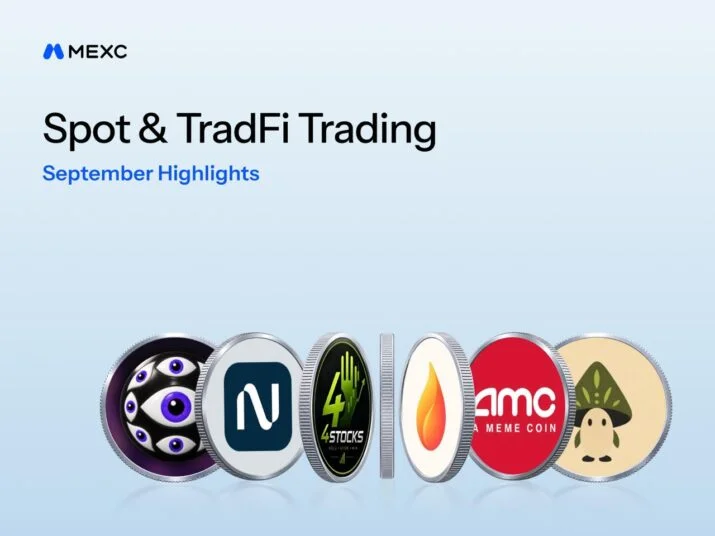
MEXC reported a significant surge in trading activity for both new crypto tokens and traditional finance (TradFi) assets in August. The number of users trading newly launched tokens increased by 21% month over month. The top-performing new token achieved an impressive gain of 14,143%, with top tokens showing an average peak gain of 3,358%. Memecoins dominated trading volume among new tokens, accounting for 55% of the total, though utility-focused projects in AI, RWA, and DeFi also saw considerable interest.In the TradFi sector, Spot trading volume grew by 13%, largely driven by a 31% increase in tokenized stock trading. Tokenized stocks and gold-related assets like PAXG were particularly active. Precious metals futures trading also rose by 32%, with gains concentrated in XAU and silver-related assets. MEXC actively supported this increased demand through promotional campaigns, including a TradFi Million-Dollar Gala which saw substantial user participation and trading volume. The platform also highlighted tokenized stocks like NVDAX and TSLAX in its xStocks campaign.MEXC's CEO emphasized the platform's commitment to providing fast and convenient access to diverse trading opportunities. The company aims to continuously expand its cross-asset coverage and reduce friction between different markets. Founded in 2018, MEXC is a global multi-asset trading platform offering 0-fee trading across crypto, stocks, and tokenized assets. It serves users in over 170 markets, providing deep liquidity and a high-performance trading experience. MEXC facilitates easier access to global trading opportunities by enabling users to trade various asset classes from a single account.
CdXz5zHNQW_q5rs1OaRY9.jpeg
CdXz5zHNQW_M75a24KHrZ.jpeg
Axis Robotics has launched Axis Sim Dataset V1, a substantial open-source simulation dataset for Franka arm manipulation. This dataset comprises over 50,000 human-teleoperated trajectories across 207 distinct manipulation tasks and 60,000 scene variations. It has become the most downloaded open-source simulation dataset for Franka manipulation on Hugging Face, with over 160,000 downloads. Benchmarks show that pretraining with V1 significantly improved performance, surpassing a comparable baseline. Axis Robotics is developing a comprehensive data engine for Physical AI, integrating large-scale simulation, real-world capture, and humanoid locomotion. The company secured $12 million in seed funding to advance this ambitious project. Their philosophy challenges the notion of relying solely on "clean data," arguing that diverse and even noisy data, when aggregated, can lead to robust policies. The dataset includes a wide array of tasks like pick-and-place, stacking, and tool use, collected via their Axis Hub teleoperation platform. Continual pretraining on V1 demonstrated consistent performance improvements as the data scale increased, indicating the benefits of diversity and coverage. Axis Robotics emphasizes that the dataset is a product of a larger, compounding data engine that continuously learns from model performance and failures. This engine utilizes simulation, egocentric real-world capture, loco-manipulation, and human-gated DAgger post-training to gather data. Beyond open-sourcing, they collaborate with robot embodiment companies to create customized data pipelines and model priors, as exemplified by their work with Booster Robotics. Axis Robotics asserts that the future of Physical AI lies in dynamic data engines, not static datasets, promoting continuous progress through scale, diversity, and closed-loop learning.
CdXz5zHNQW_X5Ws9vy7q2.png