RSS Google AI Blog
Follow
Smarter nucleic acid design with NucleoBench and AdaBeam
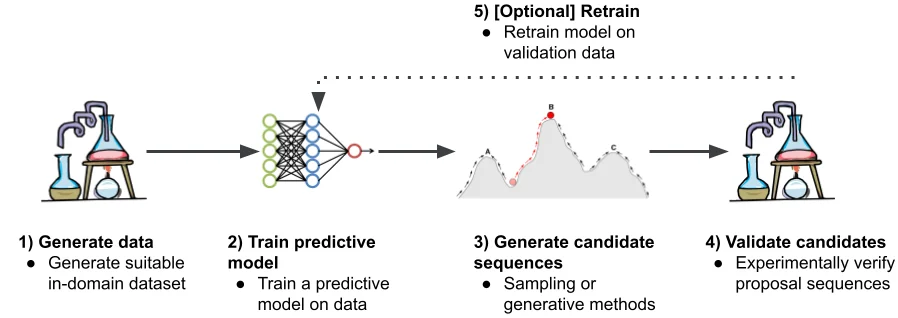
Designing therapeutic DNA and RNA sequences with specific properties is a major challenge in medicine due to the immense number of possibilities. AI can help navigate this vast search space, but evaluating design algorithms effectively has been difficult. To address this, researchers introduced NucleoBench, a standardized benchmark for comparing nucleic acid design algorithms. This benchmark involved over 400,000 experiments across 16 biological challenges. Through this work, they developed AdaBeam, a hybrid design algorithm. AdaBeam outperforms existing methods on most tasks and scales better with large AI models. The typical computational design process involves data generation, model training, candidate sequence generation, and validation. NucleoBench focuses on improving the candidate sequence generation step. Existing benchmarks often use older algorithms that don't leverage modern AI model information. NucleoBench includes both gradient-free and gradient-based algorithms for a comprehensive comparison. AdaBeam combines effective elements of existing algorithms to achieve superior performance and efficiency. It demonstrates that relying solely on gradients is not always necessary for top performance. AdaBeam's advancements include increased efficiency, smarter exploration, and reduced memory usage.