RSS Google AI Blog
Follow
Speculative cascades — A hybrid approach for smarter, faster LLM inference
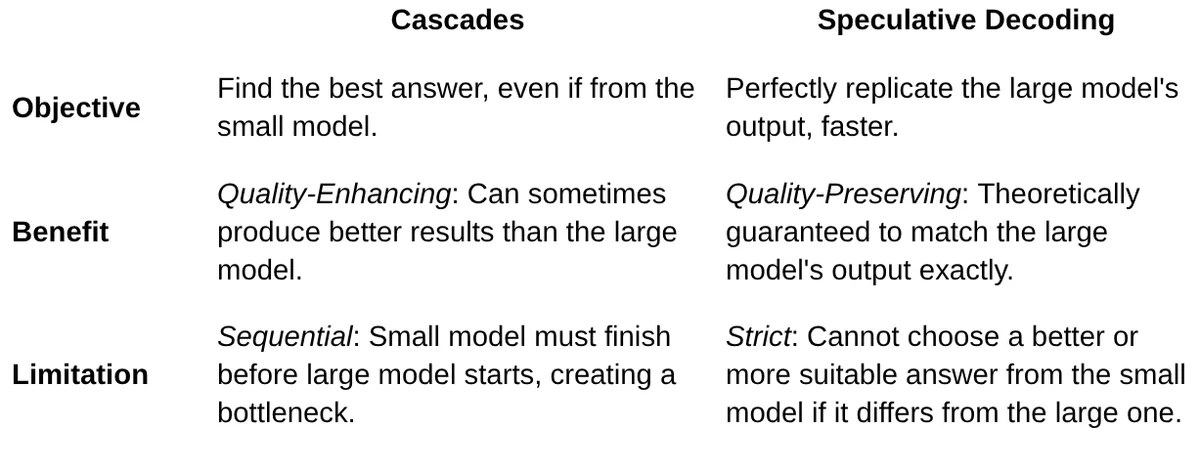
Large Language Models (LLMs) are powerful but computationally expensive, leading to slow and costly inference. To address this, cascades use smaller, faster models to handle simple queries before resorting to larger, more capable LLMs. This approach aims to reduce costs by only engaging expensive models for complex tasks. Speculative decoding, on the other hand, accelerates LLM inference by having a smaller model draft future tokens, which a larger model then verifies in parallel. This speeds up generation without changing the final output, but can increase memory usage. The paper introduces "speculative cascades," a novel method combining the benefits of both cascades and speculative decoding. Speculative cascades employ a flexible "deferral rule" that allows a smaller model's draft to be accepted even if it doesn't perfectly match the larger model's output. This hybrid approach offers better cost-quality trade-offs than either technique alone. Experiments on various language tasks demonstrated that speculative cascades achieve higher speed-ups and better quality metrics. The flexibility of the deferral rule allows for customization based on confidence, cost-benefit analysis, or token-specific checks. This innovation enables LLM applications to be both faster and smarter by optimizing the balance between computational cost and output quality.