RSS Google AI Blog
Follow
Teaching LLMs to reason like Bayesians
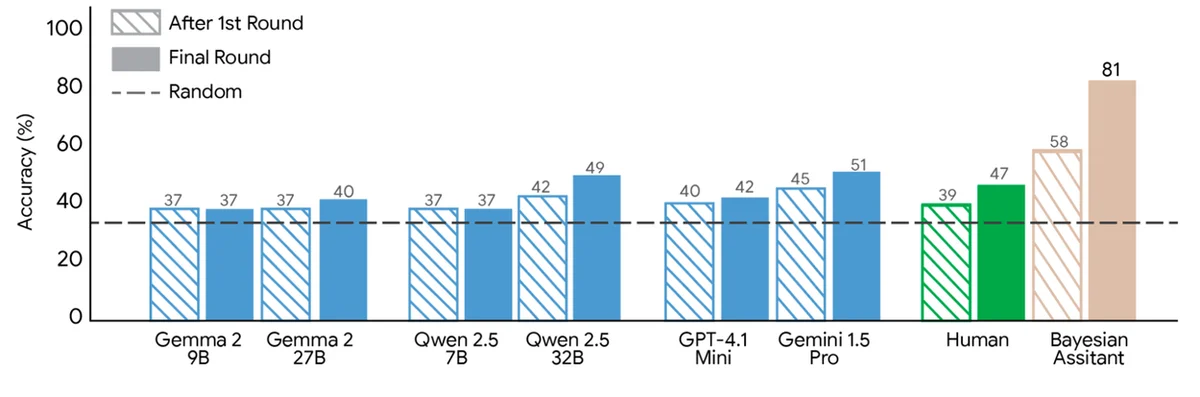
Large language models (LLMs) need to reason probabilistically to effectively interact, such as updating user preference estimates. This study investigates whether LLMs can learn Bayesian reasoning, the optimal method for updating estimations. Researchers tested LLMs on a flight recommendation task, comparing their performance to a Bayesian assistant and humans. The LLMs initially performed poorly, showing limited ability to improve recommendations over multiple interactions. A Bayesian teaching method was employed, fine-tuning LLMs using data from a Bayesian assistant. This training significantly improved the LLMs' performance on the recommendation task and enabled generalization to other tasks. Bayesian teaching, where the model learns from the Bayesian assistant's probabilistic reasoning, proved more effective than training with perfect answers. Fine-tuned LLMs showed greater agreement with the Bayesian assistant and demonstrated the ability to transfer this learned strategy to different domains. The study suggests that LLMs can learn to approximate Bayesian inference, moving beyond simple pattern matching. This approach highlights the potential of LLMs to learn reasoning skills from examples and generalize across tasks. The success of Bayesian teaching underscores the power of training LLMs on demonstrations of optimal strategies.