RSS Google AI Blog
Follow
Unlocking rich genetic insights through multimodal AI with M-REGLE
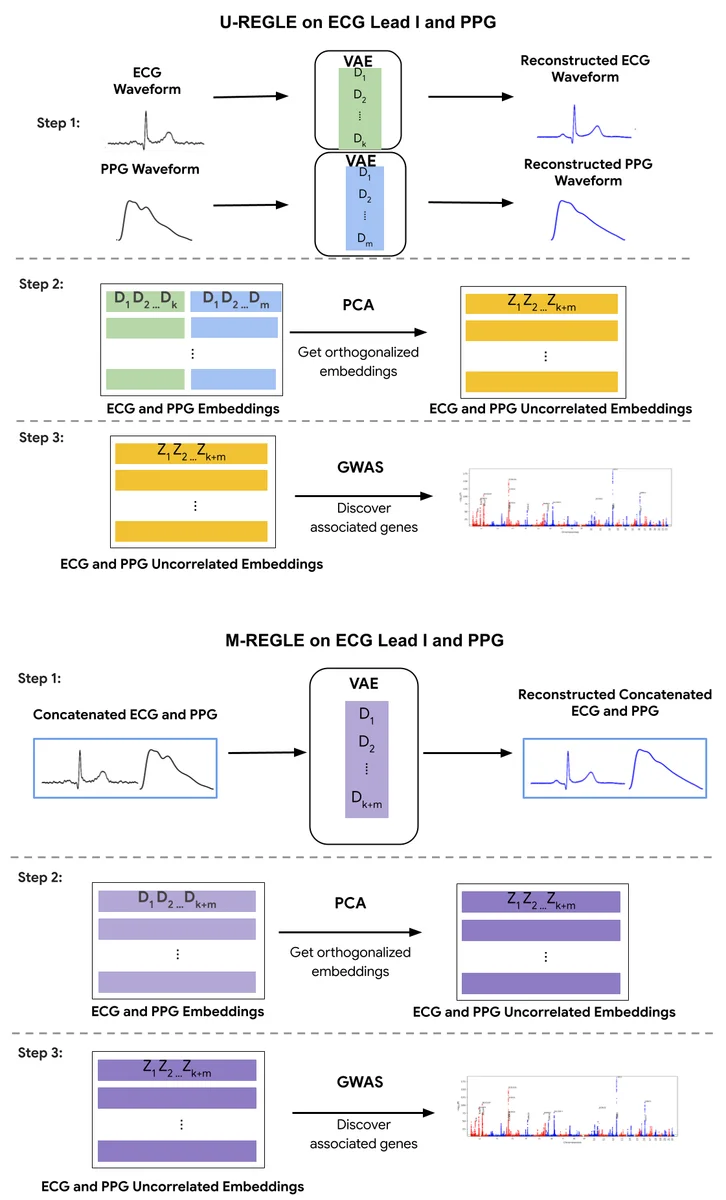
The aggregation of various health data sources, including electronic health records, medical imaging, and smartwatch data, creates a vast amount of data for researchers and clinicians to analyze. These diverse data streams often carry unique and overlapping signals, even within the same organ system. In the cardiovascular system, for example, electrocardiogram (ECG) and photoplethysmogram (PPG) data can be combined to provide a more complete picture of heart health. Integrating these physiological signatures with genetic information from large biobanks could enable the identification of the genetic underpinnings of disease. The authors developed a multimodal version of their previous model, REGLE, called M-REGLE, which allows the analysis of multiple types of clinical data together at once. M-REGLE produces lower reconstruction error, identifies more genetic associations, and outperforms risk scores in predicting cardiac disease compared to its predecessor, U-REGLE. M-REGLE employs a robust, multi-step approach that uses joint learning to combine multiple modalities, capture the most essential information, and find associations between computed independent factors and genetic data. The model advances U-REGLE to consistently produce better "learned representations" of the data, resulting in significantly lower reconstruction errors and capturing the essential information from the original waveforms. M-REGLE also made improvements over U-REGLE in the identification of genetic associations with cardiovascular disease and uncovered several new loci not previously associated with these traits. The model's polygenic risk scores significantly outperformed those from U-REGLE in predicting cardiac disease, particularly atrial fibrillation.