UX Collective | Medium
Follow
39 principles for designing human-AI interaction
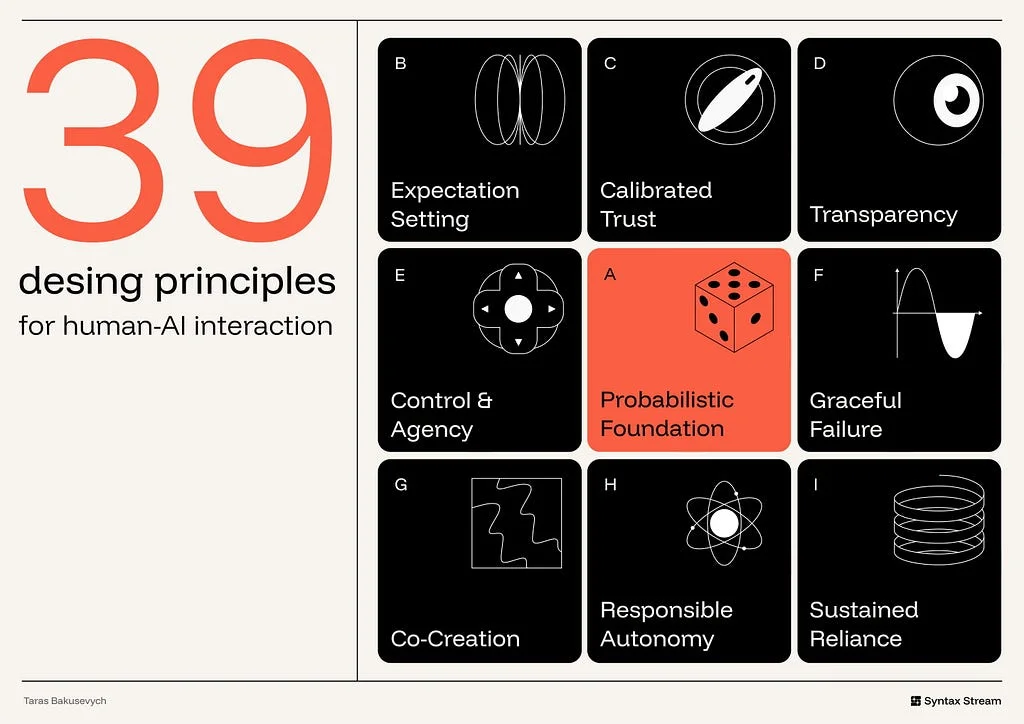
AI systems introduce unique interface challenges that traditional design conventions do not address, primarily due to their less deterministic nature. The same input can yield different outputs, making product quality dependent on more than just model capability. Key interaction problems include determining when the AI should suggest, ask, or act, how to represent uncertainty, and what evidence should accompany generated answers. These questions are crucial for users to judge output, recover from errors, and maintain responsibility for decisions. The central design goal is to help users rely on AI appropriately. This framework compiles research from human-AI interaction, mixed-initiative systems, trust in automation, and responsible AI into practical design principles. It draws upon frontier model specifications, mixed-initiative interaction work, and existing AI principles from companies like Google and IBM. Microsoft's guidelines, particularly concerning AI failure, are also influential.The framework emphasizes designing interfaces that clarify the system's role, enable understanding and verification of outputs, preserve user control, support corrections, and constrain autonomy where necessary. A probabilistic foundation acknowledges that AI models are more like probabilistic services than fixed functions, necessitating designs that account for variability in outputs. Expectation setting involves clearly stating AI capabilities and limitations, addressing the "blank canvas" problem with guidance, and framing outputs as starting points rather than final verdicts. Calibrated trust is achieved by aligning user reliance with system reliability through provenance, favoring evidence over confidence scores, and making verification easy. Transparency ensures reasoning and evidence are inspectable when needed, while control and agency are facilitated by making editing and overriding actions straightforward. Graceful failure strategies help users recover from uncertainty and errors, and co-creation treats AI output as a draft to be shaped. Responsible autonomy constrains AI actions based on stakes and permissions, and sustained reliance involves ongoing governance of quality and change over time.