UX Collective | Medium
Follow
8 voice AIUX patterns
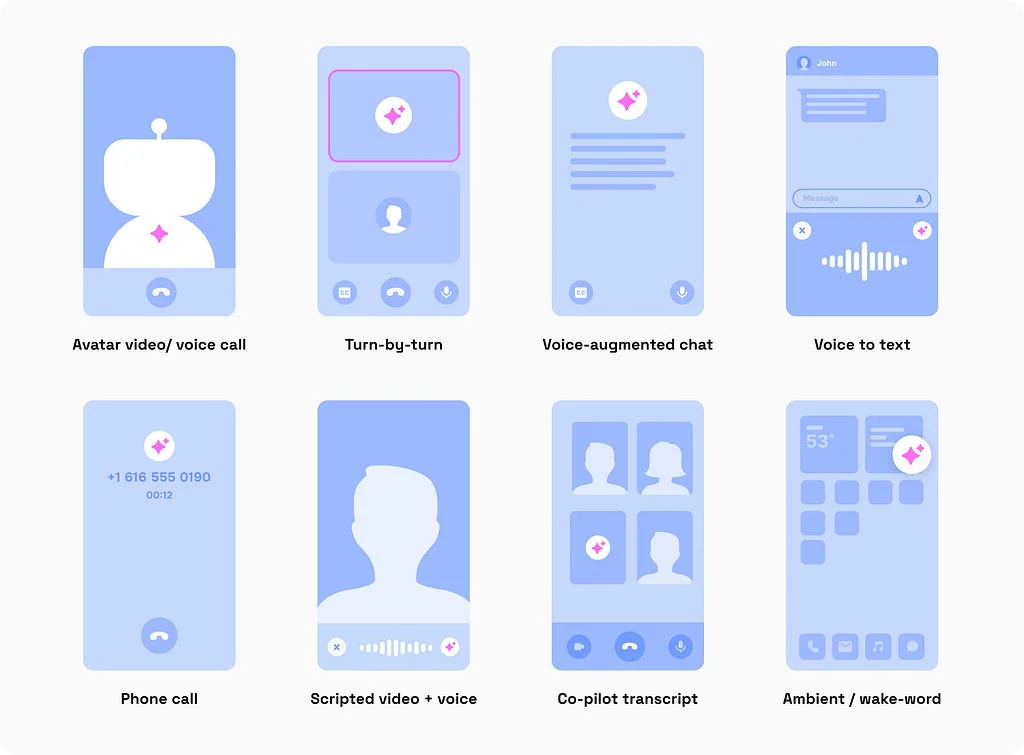
Radio Rex, the first voice-activated toy in 1922, introduced a simple principle where sound patterns triggered responses. This fundamental concept persisted for decades in voice-enabled devices, with dominant interfaces like Siri, Alexa, and Google Assistant focusing on intent extraction. Recent advancements in large language models and speech models have revolutionized voice AI, enabling new use cases and interaction patterns.This article outlines eight emerging Voice AI UI patterns, analyzing the perceived role of the AI agent, key design decisions, and limitations for each. The first pattern is the Avatar video/voice call, where an animated or hyper-realistic avatar provides face-to-face interaction, fostering a sense of connection and emotional support. Design considerations include AI personality and the challenge of navigating the uncanny valley with realistic avatars.The second pattern, Turn-by-turn, employs strict turn-taking with visual cues for speaking and listening. This is ideal for structured tutoring or assessment, where a controlled, pedagogical exchange is desired, and the absence of a face helps maintain focus on the interaction. Crucially, there's no room for interruption, limiting its application to clear-turn scenarios.AI phone calls mimic real phone interactions for customer support, lead qualification, or appointment booking. The agent acts as a voice-only service agent, relying on conversational arc design and personality conveyed solely through words. A significant limitation is the inability to scroll back, necessitating confirmation of important information.Voice-augmented chat layers voice modality onto text chat, allowing users to speak instead of type. The agent acts as a general-purpose voice assistant, appearing as a full-screen voice mode or inline within the chat. This pattern supports multimodal experiences but can limit complex outputs like code or tables that are difficult to convey through speech.Voice to text is a purely utilitarian tool that transcribes spoken input into text, without a conversational agent. Its effectiveness hinges entirely on output accuracy and its ability to adapt to context. Correcting by voice is often slower than typing, leading to solutions like custom keyboards for editing.Scripted video + voice combines pre-recorded video with voice input. A virtual tutor, perceived as a human teacher, provides feedback based on user input by selecting pre-filmed responses. This creates an immersive learning environment, but the process of filming every branch makes it costly and slow to scale or update content.