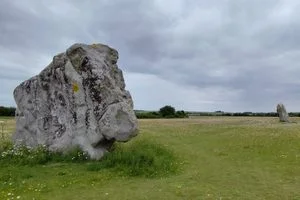
Adam and Eve (The Longstones) in Marlborough, England
Near Avebury, in a big pasture, you can find these two erected stones. A long time ago they were part of an avenue formed by two rows of stones that was nearly one and a half kilometers long. Their names: Adam and Eve stones. The other stones disappeared: some were used for building the bridge over the Winterbourne stream. If you visit Avebury it's nice to walk a bit further to take a look at those prehistorical rocks for they are a bit more than a stone’s throw away.Archaeologists believe that Adam once stood as part of a four-stone “cove” aligned to the midwinter sunrise, suggesting it was a sacred marker of the sun’s rebirth. In 2000, excavations uncovered the socket of another massive missing stone, proof that this lonely pair was once part of something much larger and more imposing.The stones also have a human history. In the 18th century, antiquarian William Stukeley recorded the site just as it was being destroyed by Richard Fowler, an innkeeper notorious for breaking up megaliths for building stone. And in 1911, Adam himself toppled over. Re-erecting him took four weeks: after modern traction engines failed, workers resorted to timber, wedges, and brute teamwork—methods that probably weren’t so different from the ones used 4,000 years earlier.Nearby lie the remains of ancient long barrows, prehistoric burial mounds that predate Avebury itself by centuries, adding another layer of mystery to this already enigmatic landscape.