Atlas Obscura | Latest Article... Note

Atlas Obscura | Latest Articles and Places

Atlas Obscura is a unique online portal that explores the world's hidden wonders, offbeat travel destinations, and unusual cultural phenomena. It is an amalgamation of a travel guide, an international magazine, a compendium of esoteric knowledge, and a community of like-minded explorers. The website is a treasure trove of intriguing articles, stunning photographs, and riveting videos that inspire curiosity and spark wanderlust. It delves into the depths of human history, delving into ancient myths, forgotten historical events, enigmatic cultures, eccentric hobbies, and curious traditions from every corner of the globe. In addition to its online content, Atlas Obscura also partners with tour operators to organize extraordinary travel experiences for its readers. These trips, known as Obscura Excursions, offer the opportunity to delve deeply into remote locations and special interests, from the magnificent caves of Croatia to the tranquil monasteries of Bhutan. Moreover, Atlas Obscura fosters a thriving community of individuals who find joy in the unconventional, the obscure, and the unexpected. Users can share their own discoveries, connect with fellow travelers, and participate in discussions about various intriguing topics. The site, therefore, transcends its function as a single-source knowledge portal, becoming a platform for intellectual exchange and camaraderie between those who dare to explore beyond the beaten path.

Thread Of Notes

CdXz5zHNQW_s8SibjMgSn.jpeg
CdXz5zHNQW_sNdWIndboA.jpeg
The Marolles district in Brussels is known for its flea market, antique shops, and friendly atmosphere, all overseen by the Palace of Justice. In 1969, a proposal to extend the Palace of Justice by demolishing several city blocks sparked fierce resistance from residents. This event became known as the ‘Battle of the Marolles’. Residents who received eviction notices within six months, without alternative housing, quickly organized with the help of their vicar. A press conference and subsequent peaceful demonstrations garnered significant media attention and support. This mobilization was fueled by the ongoing process of ‘bruxellisation’ in Brussels, where neighborhoods were destroyed for modern developments without resident consultation. The Marolles residents were aware of the devastating impact of such projects from similar demolitions in other parts of the city. Fear of facing the same fate united various Brussels districts against the plan. The widespread outcry led to the abandonment of the demolition project in early September 1969. A parade and a symbolic funeral for ‘Promoter, his faithful wife Bureaucracy and their child Expropriation’ celebrated the victory. A commemorative plaque was unveiled in Rue Montserrat, a street that would have been lost. The legacy of the ‘Battle of the Marolles’ is significant, as it led to the creation of organizations advocating for urban development. Today, citizen participation is a standard practice in Brussels for urban projects, a principle that has spread globally. The 1969 struggle established Brussels as a pioneer in involving residents in major urban development decisions. This historic battle fundamentally changed how urban planning is conducted in the city.
CdXz5zHNQW_wxNG7vXdD7.jpeg
In the early 17th century, Luxembourg City faced numerous hardships including war, famine, and the Protestant Reformation. To provide hope and promote veneration, Father Jacques Brocquart organized a procession in 1624 to erect a statue of the Virgin and Child, known as 'Notre-Dame du Glacis', outside the city fortifications. A chapel was subsequently built for the statue between 1625 and 1628. The statue gained significant recognition following the 1639 publication of the "Book of Miracles," which documented answered prayers. This led to the annual Octave celebrations, where the statue was brought to the Jesuit college church, and its designation as 'Our Lady, Consoler of the Afflicted'. It became the patron saint of Luxembourg City in 1666 and protector of the Duchy in 1678. During the 1794 French invasion, the statue was moved to the Jesuit college church for safekeeping, and the original Glacis Chapel was destroyed by revolutionaries. The church housing the statue became a cathedral in 1870, and the statue evolved into a national symbol and protector of an independent Luxembourg, particularly after WWII. A new neo-Gothic chapel was built on Glacis square in 1885, reversing the Octave tradition, with the statue now leaving the cathedral for veneration there. The Octave was extended to two weeks in 1922, though retaining its original name. In 2016, construction for a tram line uncovered the original chapel's ruins, which were protected and marked out with paving stones. Despite this, the outline is often overlooked by passers-by. Nevertheless, the rediscovery of the chapel's remains was significant, and the strong bond between Luxembourgers and their patron saint is still evident in the enduring popularity of the Octave and the traditional Mäertchen market.
CdXz5zHNQW_UUXJA1LUD0.jpeg
Seraing, a town southwest of Liège on the Meuse, is synonymous with industry, famous for its Cristallerie du Val-Saint-Lambert and the historic Cockerill steelworks. Founded in 1817 by British industrialist John Cockerill, these factories cemented Liège as the continental pioneer of the Industrial Revolution. Cockerill diversified production at the Château de Seraing, introducing the first coke blast furnace in 1821 and transforming his enterprise into a leading steelmaker. By the mid-19th century, his industry's success elevated Belgium to the world's second-largest industrial power. John Cockerill died in 1840, and his body was interred in Seraing in 1867, prompting the creation of a public monument unveiled in 1871. This monument features Cockerill on a pedestal, flanked by four worker sculptures representing key factory trades. His remains were finally laid to rest in a crypt before the monument in 1947. However, a darker history underpins this homage: a column near the monument details flood dates, revealing Seraing’s center lies permanently below the Meuse. John Cockerill's extensive coal mining for his factories inadvertently caused the ground level to sink, making frequent flooding a recurring issue. Despite constructing a protective wall and initiating the "Démergement" project to pump water back into the river, these efforts proved insufficient. In 1925, a hundred-year flood breached the wall, devastating the city center. Today, Seraing’s survival depends on continuous pumping, as stopping them would lead to rapid inundation. Ironically, Cockerill's tomb, along with the city, is now vulnerable to the very river whose resources he exploited. His statue perpetually faces the high wall separating the city from the Meuse, a stark symbol of the broken link between the town and its riverine past.
CdXz5zHNQW_2JvcbCieE5.jpeg
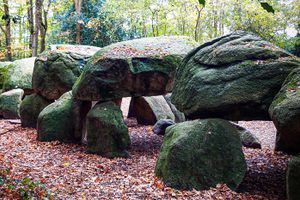
Nadrin is a small country village located between Houffalize and La Roche-en-Ardenne, almost two hours by car south-east of Brussels. Situated in the Parc Naturel des Deux Ourthes, Nadrin boasts a number of remarkable natural sites, including the Nisramont Dam, the Hérou Rock, and the archaeological site of the Cheslé fort. As you leave the village heading south-east, a group of white megaliths and a dolmen-like structure await you by the side of the road. However, this ensemble does not date back to the Neolithic period. It was created for the 1991 edition of the Europalia biennial. This biennial has been held in Brussels since 1969. It highlights the cultural scene of a country through exhibitions, concerts and other events. The rest of Belgium and even the four neighbouring countries also host events. It is in this context that the creation of the "Europalia Monument" should be seen. The inauguration of this work of art was in December 1991, in the presence of Maria Barroso, wife of the Portuguese president at the time. It consists of 12 standing stones - representing the 12 countries which then formed the European Union - and a dolmen, representing an open door. The artist chose the symbolism of the menhirs and dolmens because they are the oldest evidence of European civilisation and the remains of them can be found in all 12 of the countries that formed the EU at that time. The 24 blocks are made of pink marble from Portugal. They weigh between 1.8 and 6.6 tons. It is not the aim of the Europalia Festival to create permanent works of art. The Europalia Monument in Nandrin seems to be the only remaining work from a previous edition. It continues to symbolise the invisible links between European countries…
Rue Saint-Paul is one of the main shopping streets in Liège. In the middle of the street, a shop window stands out from all the others: it displays only contemporary works of art, which change regularly. The window and the works belong to the Uhoda Collection, the largest private collection of contemporary art in the city. The Uhoda Collection was founded in the 1970s by the brothers Stephan and Georges Uhoda. It brings together works by artists from Liège and all over the world, from the 1960s to the present day. The two brothers buy works when they fall in love with them, without any desire for consistency. In addition to supporting artists, the two brothers regularly take part in initiatives to make contemporary art accessible to everyone. The idea of exhibiting works of art directly on the street was realised in 2019 as part of Art au Centre. Launched by the City of Liège, this artistic project aims to revitalise the city centre by exhibiting works by Liège artists in unoccupied shop windows in the city centre. It takes place several times a year for about 2 months. In 2021, the two brothers decided to go even further: while continuing to participate in each edition of Art au Centre, they now exhibited works from their collection without interruption. The showcase became known as "White Cube" and had its own website. The works were exhibited day and night for periods ranging from 15 days to 2 months. The idea of buying a shop window on a high street to display works of art from a private collection on a permanent basis seems to have no equivalent. In any case, it has achieved its aim: to give passers-by free access to quality contemporary art. Anyone can take the time to admire them whenever they like, and if necessary, an explanatory text is available on the White Cube website.
CdXz5zHNQW_CbA1IBOJGa.jpeg
Braine-le-Château, a town 20 km southeast of Brussels, shares a border with Halle, home to the notable Blue Forest. The town is significantly tied to the Counts of Hornes, especially Maximilien de Hornes (1475-1542), chamberlain to Charles V. He is credited with five listed monuments in the town center, including his recumbent statue in the church, the Horne castle, a water mill, the bailiff's house, and the pillory. The Braine-le-Château pillory, built in 1521, is on the central square, demonstrating Maximilien's judicial authority. Justice, administration, and taxes were managed by the bailiff, whose house was also on the square, on behalf of Lord Maximilien de Hornes. The pillory comprises high steps supporting a column, its capital inscribed with "Maximilien de Hornes de Gasbecke, Knight of the Golden Fleece of the Emperor Charles, 1521." It also features a skylight with six columns supporting a small roof, replaced during a 2019 restoration. Under the Ancien Régime, convicts were subjected to public exposure at the pillory’s lantern on market days. In 1794, during the French Revolution, bailiff Justinien Thienpont successfully argued against the pillory's abolition, asserting its symbolic importance to the town. Although threatened again in 1839, its proposed transformation into a public fountain ensured its preservation. Two stone troughs were added in 1849, though water never flowed. The pillory officially became a historical monument on December 21, 1936, and is now part of Wallonia's exceptional architectural heritage. The latest restoration in 2019 saw the roof, whose existence was known but unrepresented, restored.
CdXz5zHNQW_fYG0N1syaO.jpeg
This small plot of land, only a third of an acre in size, is the smallest park in Harris County — and home to some of its largest public art: Mount Rush Hour. Donated to the state in 2012 by local sculptor David Adickes, the collection combines two of his famous Presidential busts with two Texas politicians, Stephen F. Austin and Sam Houston. The eighteen foot-high Statesmen rest on marble pedestals, lit at night by sconces. Every day, the Houston Chronicle estimates that they see about three million cars and trucks from their perch between Interstate 45 and The Katy Freeway. This park is only one of many final resting places for one of Adickes’ lifelong passion projects. He was on a fateful road trip past Mount Rushmore when he wondered what it might be like to look the sculptures in the eye, soon embarking on a journey that would consume over a decade of his life and lead to more than one hundred and fifty president head statues. According to The Washington Post, he was known to frequent movie theaters just to stare at the backs of old men’s heads in attempts to get the statues right. Adickes died in 2025 at the age of 98. The other 42 presidents from this set can be found at his old studio on Nance Street — and his sculptures of The Beatles (8th Wonder Brewery), Alexander Graham Bell (Hyde Park), and Virtuoso (Lyric Tower) can be spotted across the city. The other hundred president heads are split between an industrial recycling facility in Williamsburg, Virginia, and various RV parks and motels throughout North and South Dakota.
CdXz5zHNQW_CgXUx1H9mb.jpeg
Pennsylvania has a rich history in the development of wooden roller coasters, dating back to the early 20th century. These early coasters, often located at lakeside or hillside amusement parks, provided city dwellers with fresh air and excitement. Innovative engineers transformed timber into gravity-powered rides that offered unique thrills, with some still operating today. Kennywood Amusement Park in West Mifflin features several historic coasters, including the Jack Rabbit from 1920, known for its double-dip drop and enhanced wheel technology. The Thunderbolt, dating to 1924, offers steep plunges and lateral forces, while the 1927 Racer was designed as a Mobius loop. Herbert Paul Schmeck, a notable designer, contributed the Thunderhawk at Dorney Park & Wildwater Kingdom in Allentown, a classic out-and-back design built in 1923. Idlewild & SoakZone's Rollo Coaster, built in 1938, was constructed using local materials and embraces its wooded hillside setting. Knoebels Amusement Park in Elysburg is home to the Phoenix, a reborn coaster that has won numerous awards, and the Twister. Hersheypark in Hershey showcases the Comet, a relocated 1946 coaster recognized for its airtime hills and Landmark status. More recently, Waldameer Park in Erie features the Ravine Flyer II, built in 2008, which is Pennsylvania's tallest and fastest wooden coaster. Finally, Hersheypark's Lightning Racer, built in 2000, is a popular racing wooden coaster that demonstrates the continued evolution of the ride type.
CdXz5zHNQW_AI4HlDCg49.jpeg
CdXz5zHNQW_Rd0YTPsdqo.jpeg
In the foothills of the Sierra Nevada Mountains is the small town of Oakhurst, California.  Once a cattle stop and logging town, Oakhurst became known in more recent times as the home of Sierra On-Line, a pioneer in the computer gaming industry.  Oakhurst is also a gateway to the southern entrance of Yosemite National Park and calls itself the “Carved Bear Capital of the World." Most of Oakhurst's bears are carved from wood repurposed from trees lost to drought or bark beetle infestation.  However, its most notable ursine inhabitant may be “The World Famous Talking Bear.” This molded fiberglass and steel-reinforced statue of a grizzly bear was manufactured by the Alpine Fiberglass Menagerie Co. of Alpine, California, a company recognized for creating large statues used as roadside attractions The Talking Bear is posed with an open mouth of bared teeth and a front paw raised to swipe, while his other paw rests on a grey rock.  His brown fur is heavily textured, and he sports the classic grizzly hump on his back.  When a button is pressed, the Bear vocalizes from a nearby speaker, letting out a growl followed by some California bear facts and history Legend says that the Bear was originally created as an enticement to the International Olympic Site Selection Committee.  The inducement failed. However, in 1965, Hugh Schollenberger placed the fiberglass Bear at the intersection of Crane Valley Road and State Route 41 in the center of Oakhurst, and the Bear has presided there ever since.  He endures annual holiday decorations on his island of grass and has even been spotted wearing a festive scarf in cold weather.
CdXz5zHNQW_wIx10fjmK9.jpeg
The statue of Skuli Magnusson was erected in 1954 to mark a century of free trade in Iceland. Skuli Magnusson was born in the remote village of Keldunes in the north east of the country.  He moved to Húsavik with his family before joining a Danish merchant's company as a teenager.  Upon joining the company he was told by the merchant to "weigh it right", meaning to cheat customers.  This made Magnusson angry, and he swore he would strive to replace the dishonest merchants. Magnusson then took up a position in the south of Iceland as a county magistrate before moving to Skagafjörður in the north of the island 3 years later.  While in this position he discovered a Danish trading ship had foundered in the fjord and was illegally trading with locals.  He seized the ship and cargo and used it to build Akrar village. Magnusson had a vision to use his wealth and power to destroy what he saw as a corrupt system and help strengthen the country.  Magnusson sued a corrupt merchant for dealing in mouldy flour, poor quality iron and for selling over the maximum price.  He won, becoming popular with the Icelandic public.  Magnusson became the first Icelandic Governor in 1749 when the Danish Governor was dismissed for drunkeness and bankruptcy. Magnusson came good on his vision of improving the country by build factories which focused on sulfur processing, developing agricultural machinery, wool weaving, dyeing, leather working, rope-making, fishing and shipbuilding.  He also pushed for Icelanders to use boats with a deck so they could fish deeper waters in safer vessels than the previously used rowing boats.
CdXz5zHNQW_Bq8XnZOm1S.jpeg
CdXz5zHNQW_Hyu1dQbdht.jpeg
CdXz5zHNQW_ZZIxvBvraJ.jpeg