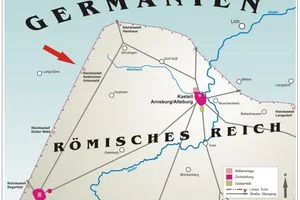
Kleinkastell Holzheimer Unterwald in Pohlheim, Germany
The Roman Empire constructed the Limes, a fortified border, to defend its territories. This extensive line stretches across Europe, with significant portions in Germany known as the Rhaetian and Upper Germanian Limes. Some remnants of this border, including guard towers and forts, are still visible today. In recognition of its historical importance, the Limes and its structures were designated a UNESCO World Heritage Site in 2005. Following a major defeat in 9 AD, the Romans began fortifying their borders in Germanic territories approximately a century later. The Limes was primarily characterized by wooden palisades, punctuated by numerous guard towers and forts for constant surveillance. Kastell Holzheimer Unterwald serves as an example of a small fort located directly on the Limes, housing around thirty soldiers. This fort, measuring only 19 by 17 meters, contained barracks, a well for water supply, and a fortified gate with a drawbridge. Notably, Kastell Holzheimer Unterwald lacked a parapet walk and featured unrounded corners, distinguishing it from other forts. Archaeological findings, including coins dating back to 69 AD, indicate long-standing Roman interest in the fertile Wetterau region. Excavations have allowed for the reconstruction of the fort's base, which can be viewed and explored today, alongside explanations of its history and construction. The well-preserved Limes ridge near the fort enhances the visitor's ability to visualize the ancient Roman defense system.