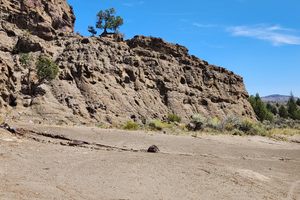
The Lost Forest in Christmas Valley, Oregon
In the Pleistocene, ponderosa pine forests extended much farther east into central Oregon than they do at present, reflecting the cooler, wetter climate then prevailing. As the climate warmed and dried, these forests were largely replaced by the current scrub vegetation, including sagebrush, juniper, pinyon pine, and similar arid-adapted species.The exception is here, where a sparse stand of ponderosa pine lingers among the more typical scrub vegetation such as juniper and sagebrush. This remnant forest now lies over 40 miles from the nearest other ponderosa pine occurrences and somehow manages to survive on half the usual rainfall needed to support these trees. Nearly 9,000 acres of this anomalous occurrence were preserved in a designated research area, The Lost Forest Research Natural Area, in 1972.The reason for the anomalous survival of the ponderosa pines proved to be straightforward. The sandy soils in which the pines are rooted are underlain by a nearly impermeable clay-rich layer, which traps rainfall in a near-surface groundwater layer that can be reached by the pines' roots. This clayey layer is a hardpan from an ancient lakebed, which is exposed farther west.