DEV Community
Follow
AI Agent Architecture Patterns: A Deep Dive into Modern Agent Design
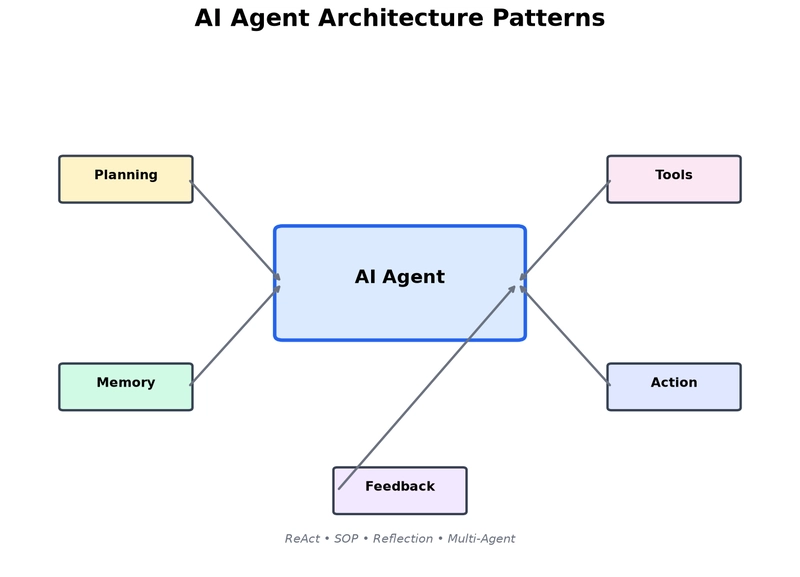
AI agents are revolutionizing technology interaction, driven by sophisticated architectures. An AI agent perceives its surroundings, makes decisions, and acts to achieve goals, going beyond chatbots by planning multi-step tasks, using external tools, learning from feedback, and collaborating. The ReAct pattern integrates reasoning and acting in a cycle of observing, reasoning, acting, and observing results to tackle complex tasks. SOP agents execute tasks by following predefined decision trees with specific conditions and tool usage, ensuring consistency and reliability. Reflection agents enhance quality by generating, critiquing, and revising their own outputs in a self-correction loop. Multi-agent systems leverage specialized roles like planners, executors, critics, and coordinators for better outcomes in large-scale projects. ReAct suits complex reasoning, SOP is ideal for repetitive workflows, Reflection excels in quality-critical tasks, and Multi-Agent systems are best for large projects. Future advancements will likely bring more sophisticated planning, tool integration, memory, and collaboration. Selecting the appropriate architecture is crucial for designing effective and reliable AI agents. Understanding these patterns empowers developers to create better AI systems.