Google Cloud Blog
Follow
AI Innovators: How JAX on TPU is helping Escalante advance AI-driven protein design
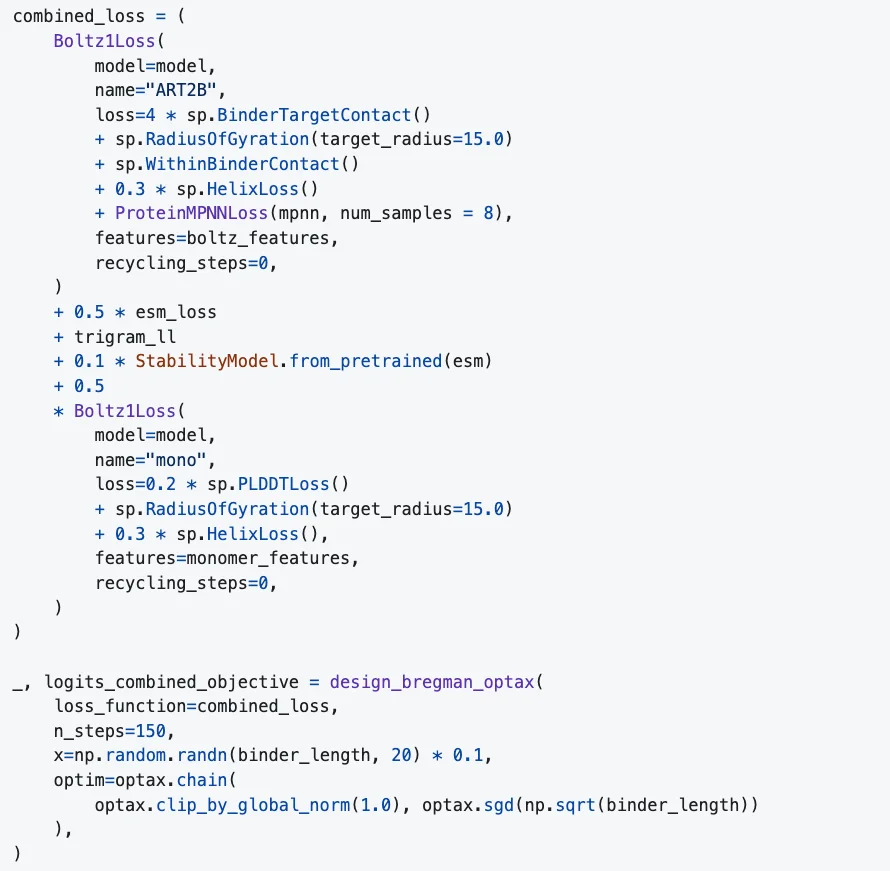
JAX, a Python library for accelerator programming and program transformation, is proving vital for AI-driven protein engineering, extending its impact beyond large-scale AI model training. Escalante, a startup, uses JAX to train models that predict drug effects on cellular protein expression levels, illustrating JAX's functional and composable nature. Their long-term vision is to design drugs from scratch, but they initially focus on generating crucial biological datasets by developing new lab assays. Protein engineering involves multi-objective optimization, requiring proteins to meet various criteria like binding, solubility, and stability. JAX simplifies integrating numerous AI models, each predicting a different property, into a unified loss function. Escalante embraced the JAX ecosystem, even translating models from other frameworks like PyTorch. This allows for an expressive language for protein design, where models can be composed and transformed into a final objective, all optimizable with jax.jit for performance. Their workflow inverts typical training by optimizing input sequences using a collection of fixed neural networks as a complex, differentiable loss function. This process is analogous to DeepDream, where gradients guide sequence updates towards desired properties. JAX's automatic differentiation and compilation capabilities are crucial for optimizing these sophisticated loss functions. The framework’s native integration with TPUs facilitates scaling these workloads, with Escalante employing a pattern of spinning up and shutting down TPUs as needed. This TPU adoption offers significant cost-effectiveness over GPUs for their large-scale jobs. Key JAX ecosystem libraries like Equinox and Optax are utilized for model representation and optimization algorithm flexibility. The combination of JAX's functional core, its ecosystem libraries, and scalable TPU hardware enables Escalante's groundbreaking research.