DEV Community
Follow
AI Model Evaluation: Best Practices for Testing and Validation
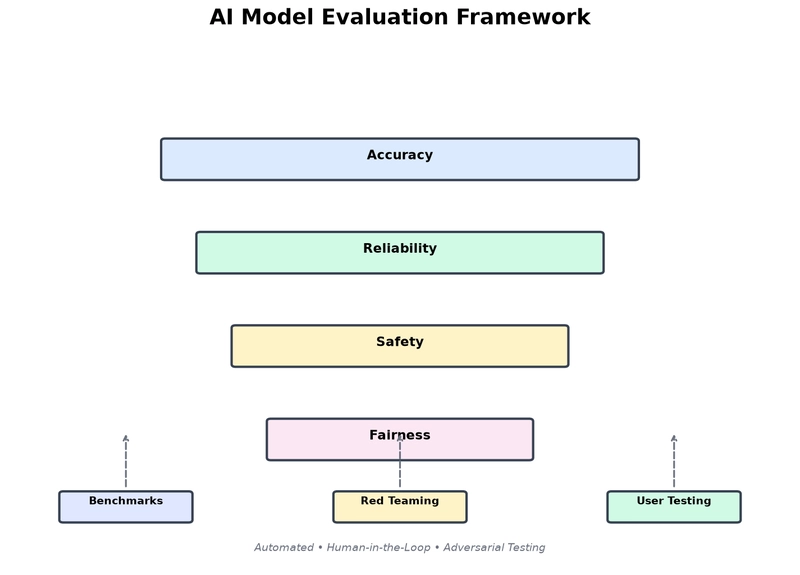
Evaluating AI models is essential for ensuring their quality, safety, and reliability. It helps identify mistakes, biases, and unexpected behaviors. Key benefits include verifying quality, detecting bias, ensuring safety, and measuring real-world performance.A robust evaluation framework includes standardized benchmarks like MMLU for knowledge and HumanEval for code generation. Red teaming involves adversarial testing to uncover security vulnerabilities, potential jailbreaks, and robustness issues. User testing gathers crucial real-world feedback through methods like A/B testing and surveys.Important evaluation metrics include accuracy, latency, fairness, robustness, and safety. Best practices emphasize multi-dimensional testing, continuous evaluation, and incorporating human review. Documenting and sharing evaluation results are vital for improvement and collective learning.Various tools and frameworks support this process, such as MLflow for experiment tracking and DeepEval for evaluation. The future of AI evaluation points towards more sophisticated methods like automated red teaming and real-time monitoring. Ultimately, model evaluation is an ongoing, multi-faceted process, not a single event.