ZeroHedge News
Follow
America Looks Richer Than Ever. What Happens When The Fed's Asset Bubble Bursts?
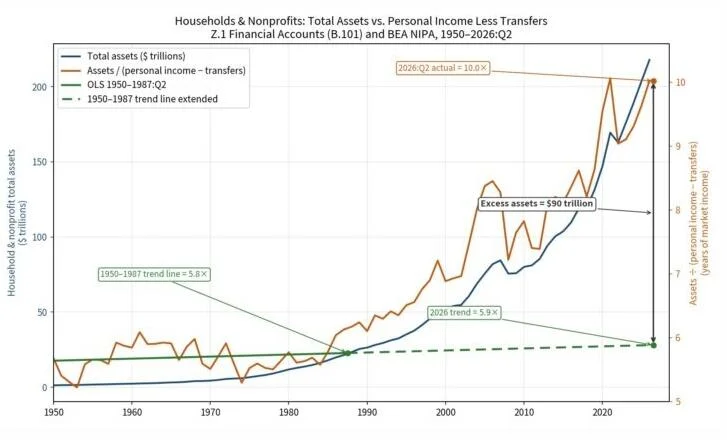
The Federal Reserve's monetary policies are deemed ineffective and detrimental. Since 1987, household asset growth has significantly outpaced earned income growth. During the prosperous period from 1950 to 1987, household assets grew in lockstep with earned income. Post-1987, however, the Fed's policies led to a dramatic surge in household assets, adding trillions more than historical trends would suggest. This massive increase in net worth is not primarily due to savings from earned income. While borrowing played a modest role, the main driver was the inflated growth of asset values. The disparity between asset growth and income growth highlights how the Fed inflated asset prices. Concurrently, the household savings rate has steadily declined since the mid-1970s. Real savings growth has also been anemic, contradicting the idea that Americans saved their way to current net worth. The distribution of this wealth surge is highly unequal, with the bottom 50% receiving a small fraction and the top 1% capturing a substantial portion of the gains. This unequal distribution is directly linked to the Federal Reserve's actions. The article argues that the rich get richer not through a free market but through Fed-induced inflation. This inflationary bubble, created by the Fed, ultimately represents a failure of central banking. The author concludes that easy money, not the free market, is the true culprit behind these economic issues.