Google Cloud Blog
Follow
Beyond Static Prompts: Building Scale-Proof, Polymorphic Multi-Agent Systems with Google's ADK
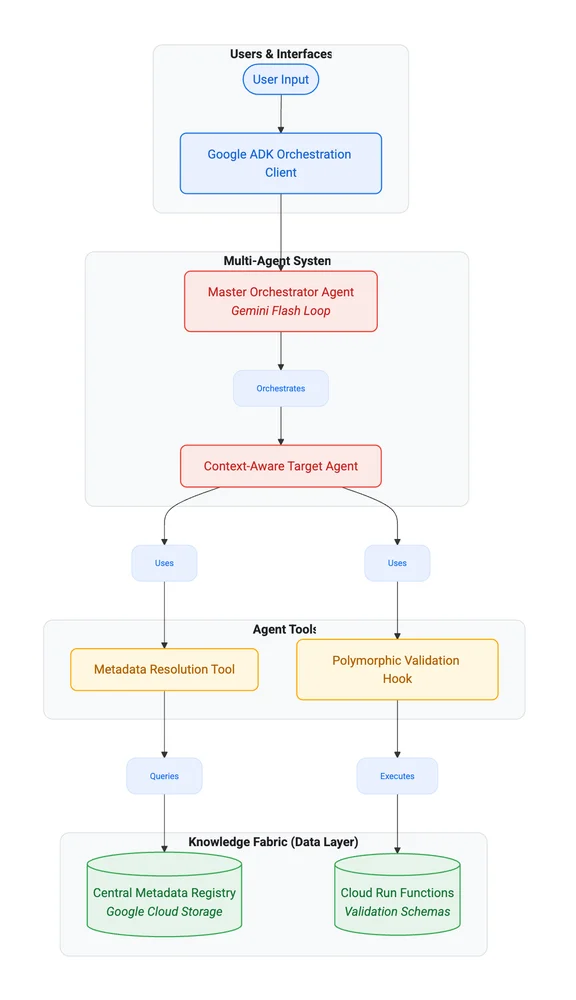
Enterprise generative AI faces scalability issues as it moves beyond simple chatbots to complex autonomous workflows. Traditional static prompting, where all schemas are pre-loaded, leads to context window bloat, high costs, and reduced accuracy due to attention diffusion. This architecture struggles with hundreds of data structures and dynamic business rules. A new approach is needed to decouple agent reasoning from structural data requirements. This post introduces Context-Aware Polymorphic Schema Validation, a pattern using a metadata registry for dynamic context injection and runtime schema enforcement.Static agent architectures lead to context window bloat, latency, and attention diffusion, where models mix irrelevant schemas. Maintaining synchronous code and validation becomes difficult, creating debt. Multi-agent handoffs lack deterministic checks, leading to silent failures. The proposed architecture externalizes schemas into a centralized metadata registry, separating execution into context discovery and dynamic validation. Schemas are stored as JSON descriptors containing field definitions, mapping rules, and validation hooks.The dynamic discovery and validation loop begins with a lightweight discovery prompt. The agent first distills user intent without heavy schema constraints. Once intent is clear, it loads specific schema rules from the metadata registry into session memory. The system then enters an evaluation loop, asking for precise fields and sending raw input to a separate Polymorphic Validator. If validation fails, an error code triggers self-correction; if it passes, the field is committed to the master JSON payload.Finalization occurs only when the master payload fully complies with metadata criteria, enabling secure downstream API calls or clean multi-agent handoffs. This design pattern, implemented on Google Cloud, utilizes ADK for multi-agent coordination and Gemini Flash for fast, cost-effective inference. Cloud Storage acts as the externalized storage for schema descriptors, which can be updated by administrators without code deployment. Cloud Run functions provide decoupled, programmatic validation hooks.This shift to dynamic schema architecture offers significant business and operational advantages. It ensures 100% reasoning density by avoiding context clutter, drastically reducing costs and hallucinations. Adaptability is achieved through zero-downtime updates by simply modifying schema descriptors in the registry. Deterministic state enforcement eliminates silent multi-agent failures by validating context before hitting enterprise applications.