Beyond Two Towers: Launching the 3-Tower Engagement Co-Train Model (Part 2)
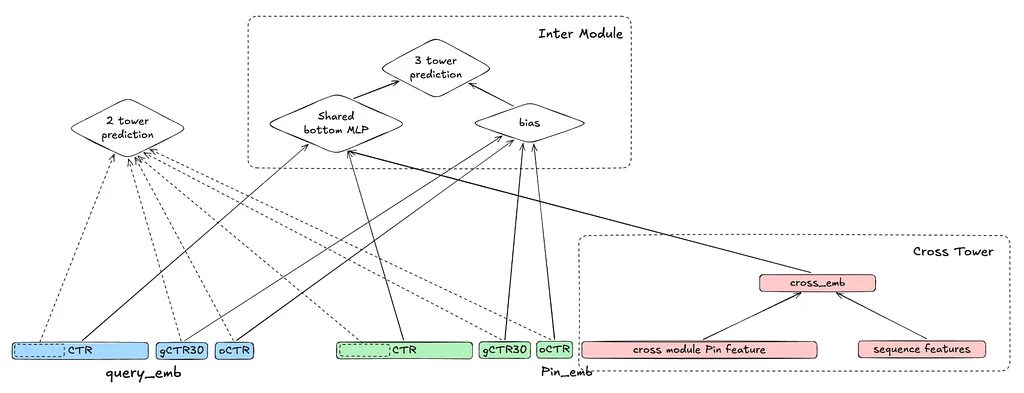
Pinterest has developed a new lightweight ranking model called Nexus, which moves beyond traditional two-tower architectures. This model jointly predicts click-through rate (pCTR), good click-through rate (pGCTR30), and outbound click-through rate (pOCTR). To efficiently support these predictions, embeddings are segmented for each task. The Nexus system allows for more complex model architectures like cross-attention and sequence modeling. However, scoring hundreds of thousands of candidates per request poses significant latency and cost challenges. To address this, a 3-tower co-train model was designed, combining a fast two-tower prediction with a richer three-tower prediction.This architecture retains the original query and Pin towers for efficient caching and dot-product predictions. It introduces a third cross tower using attention between user sequences and candidate features, and an inter module to combine these embeddings. The model is co-trained, enabling a fast score for all candidates and a more accurate score for a subset. This approach balances performance and latency by allocating compute where it's most impactful. The cross tower captures high-order interactions, while the inter module generates a shared representation for all tasks.The training process employs a multi-task loss function, weighting the main three-tower losses more heavily than auxiliary two-tower co-train losses. This ensures the three-tower predictions are the primary optimization target while maintaining the quality of the fast two-tower predictions. Significant serving optimizations were implemented to manage the computational cost. These include pre-processing Pin features in the Pin tower to avoid per-request computations and utilizing lower precision inference with BF16. These optimizations reduced P99 model inference time dramatically, making the three-tower approach practical at scale. The combined changes led to substantial offline loss reductions and positive online business metrics.