Google Cloud Blog
Follow
BigQuery Graph is now GA: the knowledge foundation for the agentic era
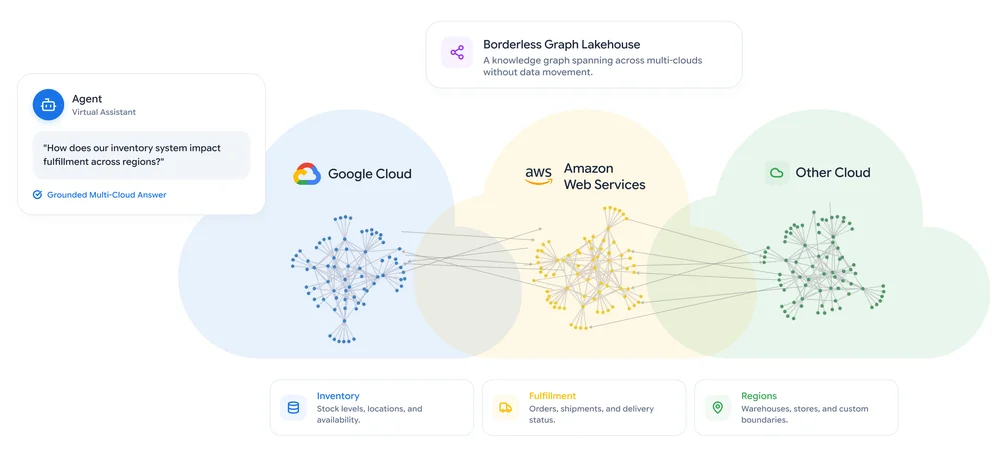
BigQuery Graph, now generally available, integrates native graph analytics directly into the data warehouse, eliminating silos and operational overhead. This new capability allows users to perform complex graph queries alongside traditional SQL using the ISO-standard GQL. It leverages BigQuery's petabyte-scale processing, existing security measures, and integrates with BigQuery ML and AI functions. Data teams across various industries, including cybersecurity, finance, retail, and IT, are adopting BigQuery Graph. Use cases include threat and fraud detection, supply chain optimization, customer 360, knowledge graph creation, and network management.Recent enhancements include a faster and broader graph engine, offering improved GQL execution speeds and expressiveness. The new borderless Graph Lakehouse feature enables BigQuery Graph to span data residing in native BigQuery tables and open Iceberg tables across different clouds without data movement. This allows agents to traverse virtual knowledge graphs composed of data from multiple sources, like a support agent querying customer and product information across Google Cloud and AWS. Conversational analytics enables natural language interaction with graphs, reducing ambiguity and hallucination for AI agents. Furthermore, agents can now build graphs by translating datasets into nodes and edges, with capabilities for authoring and verification. The context graph feature provides an auditable memory for AI agents, capturing their reasoning and decisions as a queryable trace within BigQuery Graph. This ensures explainability and forms the basis for improving future agent actions.