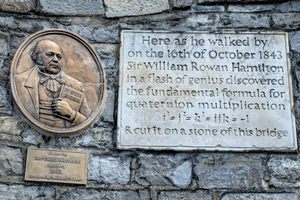
Broom Bridge in Dublin, Ireland
On the 16th of October, 1843, the legendary Irish scientist and mathematician Sir William Rowan Hamilton went on a walk with his wife. As he walked along the banks of the Royal Canal, he had a famous eureka moment.Hamilton had been working on the problem of representing the rotations of three-dimensional objects for years. In a flash of insight, he discovered the formula for the algebraic system of quaternions, and so as not to forget, carved it into Brougham Bridge with his pocket knife: i² = j² = k² = ijk = -1. A commemorative plaque now marks the spot of Hamilton's mathematical graffiti, which has since faded away. Quaternions are a system of four-dimensional numbers, and their discovery is credited with "liberating algebra" from the idea that all algebraic systems should follow the rules of ordinary numbers. It can be claimed, then, that this bridge marks the birthplace of modern algebra. They also have applications in numerous scientific fields. There are few places in the world in which the exact time and location of a breakthrough discovery can be determined. Perhaps that's why, every year on the anniversary of this event, there is a Hamilton Walk in which mathematicians and other interested parties go on a pilgrimage to the site. Past participants include Nobel and Fields recipients, such as Roger Penrose and Efim Zelmanov.