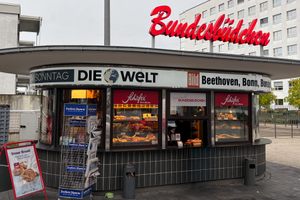
Bundesbüdchen in Bonn, Germany
In 1949, Bonn was chosen as West Germany's provisional capital, a modest choice reflecting a desire for a fresh start. This university town, birthplace of Beethoven, had minimal wartime damage and lacked strong ties to the Reich. However, Bonn's limited culinary infrastructure posed a challenge for politicians.To address this, the Bundesbüdchen, a federal kiosk, was erected in 1957 by the Rausch family. It quickly became a vital hub, serving sausages, sandwiches, and pastries to politicians, diplomats, and reporters. The kiosk evolved into a symbol of postwar democracy, known for its unpretentious charm and as a place for casual interactions.Notable figures like Joschka Fischer and Hans Dietrich Genscher were frequent patrons, reinforcing its iconic status. Former Labor Minister Norbert Blüm affectionately described it as embodying Bonn's lovable, non-pompous spirit. However, the reunification of Germany in 1990 led to the Bundestag's relocation to Berlin.In 1999, the government offices moved, transforming Bonn's former parliamentary buildings. The Bundesbüdchen was subsequently stripped of its advertisements and moved to storage in 2006. Determined to preserve its legacy, Jürgen Rausch and local stalwarts formed a society.They secured a city council resolution and a grant to re-establish the historic structure. In May 2020, the kiosk was wheeled to Heussallee, near its original spot, and restored to its Cold War-era appearance. Today, it serves visitors to the UN Campus and World Conference Center, offering a tangible link to the Bonn Republic.The Bundesbüdchen remains one of the most accessible and living remnants of that era. Its historical significance is even recognized in Berlin, where a Bundesbüdchen restaurant opened in 2025. This restaurant, though upscale, features a bar that replicates the original Bonn kiosk.