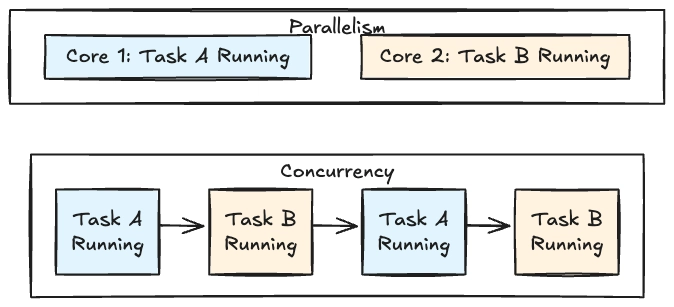
The article explores concurrency and parallelism, differentiating their meanings and understanding the trade-offs of shared memory and message passing. It introduces Amdahl's and Gustafson's Laws, illustrating the limits of parallelization. It then highlights four concurrency bug patterns to avoid. The article proposes a three-layer mental model for designing concurrent systems: architecture, task decomposition, and state management. Task decomposition patterns like fork-join, map-reduce, work stealing, and master-worker are explained. Architectural patterns, including pipeline, producer-consumer, and scatter-gather, are outlined for data flow. Finally, it delves into asynchronous patterns, the actor model, CSP, futures/promises, and reactor/proactor designs. The patterns help manage I/O wait times and enable the building of scalable, efficient concurrent systems. Modern design utilizes a combination of these patterns.

dev.to
dev.to

RSS Hunter
2026-02-08
Create attached notes ...