Google Cloud Blog
Follow
Do more with less: How GKE can reduce your cost per agent by 75%
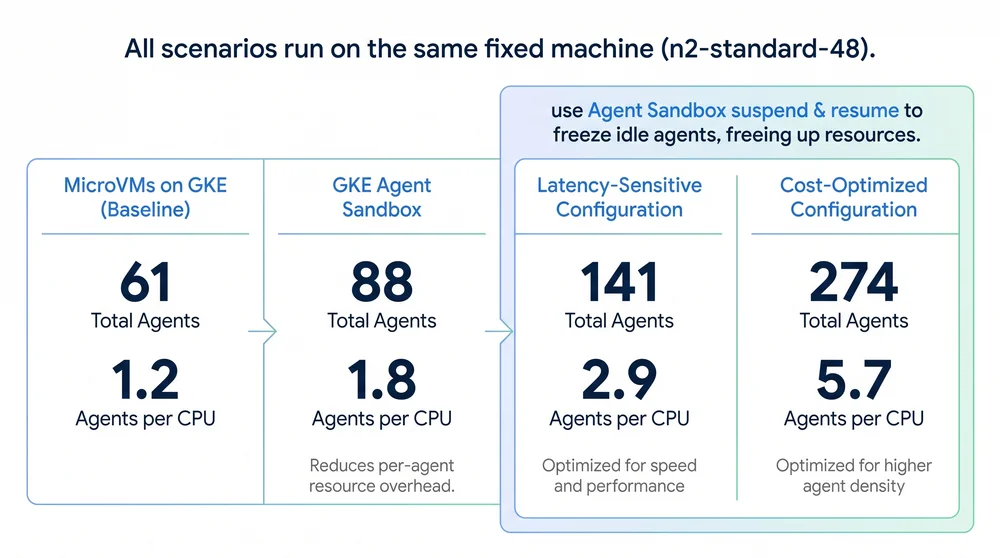
Modern cloud applications are becoming autonomous digital workers capable of reasoning and taking action. Initially, deploying agents on virtual machines with frameworks like OpenClaw is a simple approach. However, as these workloads scale, the bursty nature of AI agents leads to inefficient resource consumption with idle agents still using CPU and memory. The challenge is to pack more agents onto fixed compute without sacrificing reliability or efficiency. Orchestration, when incorporated into the architecture, significantly improves economics, scalability, and reliability. Google Kubernetes Engine (GKE) offers sophisticated orchestration capabilities to maximize compute capacity. A baseline test running OpenClaw agents on microVMs hit a scaling limit of 61 agents due to the overhead of guest operating systems. Migrating to GKE Agent Sandbox, which uses the lightweight gVisor for isolation, increased agent density by 44% to 88 agents on the same node. This optimization also reduced the cost per agent by over 30%. Further enhancing density involves using GKE Pod snapshots with suspend and resume features to checkpoint idle agents, freeing up resources. This allows for oversubscription of compute capacity, but requires tailoring strategies for different agent latency requirements. GKE enables simultaneous support for latency-sensitive, balanced, and latency-tolerant agent workloads. By combining GKE Agent Sandbox with suspend and resume, agent density can be increased up to 3.5 times and costs reduced by up to 75% for intermittently active agents. Ultimately, scaling agents efficiently in the agentic era is achievable by leveraging platform features and integrating orchestration from the outset.