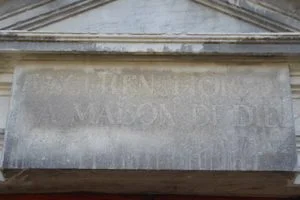
‘Dogs Out of God’s House’ Inscription in Andenne, Belgium
Andenne, situated on the Meuse River southeast of Brussels, is renowned for its ceramics and the Collegiate Church of Saint Begga. The current neoclassical church, designed by Laurent-Benoît Dewez, was rebuilt between 1764 and 1778. It replaced an earlier monastery founded in 692 by Sainte-Begge, which legend says was marked by a hen hatching seven chicks near a spring, symbolizing eight religious buildings. A more likely explanation is a reference to the seven great churches of Rome, attracting pilgrims. The spring, now Fontaine Sainte-Begge, also served as the town's washhouse. The new church's north-south orientation, unusual for Christian tradition, is thought to have been to face the Meuse for travelers. This orientation, however, complicated access for townspeople and women going to the washhouse. To facilitate passage for worshippers, two entrances were added in the aisles. Women using the washhouse often cut through the church, a route tolerated to avoid passing canon houses. To deter animals, an inscription reading "Les chiens hors di la maison de Dieu" was placed above the side entrances. This inscription, possibly from 1784, is documented in Victor Hugo's 1842 work. Washing machines eventually eliminated the need to pass through the church, preserving the memory of women accessing the washhouse without their dogs.