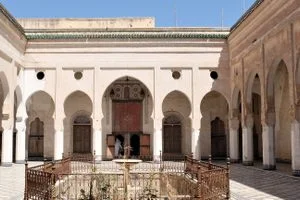
El Glaoui Palace in Fez, Morocco
Encompassing twelve houses and several annexes, El Glaoui Palace is more a palatial complex than a palace per se. The initial construction began around 1860, with additions continuing through the late 19th and early 20th centuries. Originally, the palace was built by Haj Omar Tazi, the Finance Minister of Morocco. However, in 1907, the powerful Glaoui family seized the property, marking the start of their rise to prominence.No account of El Glaoui Palace would be complete without acknowledging the controversial legacy of the family that owned it. There is no doubt that the Glaoui collaborated with the French colonial authorities, and there is some convincing evidence that they either orchestrated or, at the very least, approved of the exile of King Mohammed V. Brutality was a defining trait of their ruling style, with enemies not merely defeated but often subjected to grisly displays, such as heads impaled on spikes along the kasbah walls.Upon taking possession of the palace, the Glaoui family ensured that it was outfitted with the most up-to-date facilities. It is often said that the El Glaoui Palace was the first building in Morocco to be equipped with electricity and central heating. This claim is probably true as long as private buildings are concerned. The palace also encompasses several courtyards, gardens, and fountains. Due to the piecemeal additions through the years, unconventional passages were created between different parts of the palace, which fuelled speculations that there must be secret passages, or even tunnels connecting El Glaoui Palace with other palaces owned by prominent families.Nowadays, some sections of the complex are privately owned, while others are open for the public to appreciate the architecture of El Glaoui Palace. As of 2025, some rooms of the palace are used for showcasing artwork of Amazigh artists, including the caretaker-artist Abdou.