DEV Community
Follow
EU AI Act Voice Watermarking: What TTS Builders Must Know
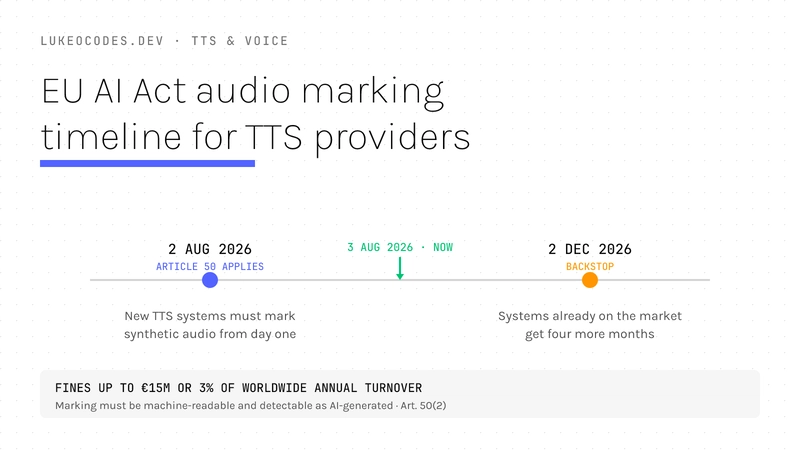
The EU AI Act's voice watermarking rules, effective August 2, 2026, mandate machine-readable marking for AI-generated audio. Failure to comply risks fines up to EUR 15 million or 3% of global turnover. Providers of AI systems creating synthetic audio, including text-to-speech and voice clones, must ensure their output is detectable as artificial. The law emphasizes an outcome-based approach, requiring effective, interoperable, robust, and reliable marking where technically feasible. A layered approach, combining inaudible watermarks with signed metadata, is becoming common. AI systems interacting with humans must also disclose their AI nature, and deepfakes require disclosure. The European Commission provided guidelines and a Code of Practice for compliance, with many companies signing up. Existing systems have a grace period until December 2, 2026, for marking compliance. Exemptions are limited to assistive editing functions that do not substantially alter audio. TTS providers are adopting methods like Google's SynthID and Meta's AudioSeal for watermarking. OpenAI's API allows verification of embedded signals, though it cannot detect unmarked or stripped content. Developers must audit their audio outputs, verify watermark survival through their pipelines, manage disclosure obligations, and maintain generation records. Ignoring these regulations carries significant financial and reputational risks.