DEV Community
Follow
Evolution of Accuracy and Visual-Cognitive Errors in a Decade of Vision-Language AI Models
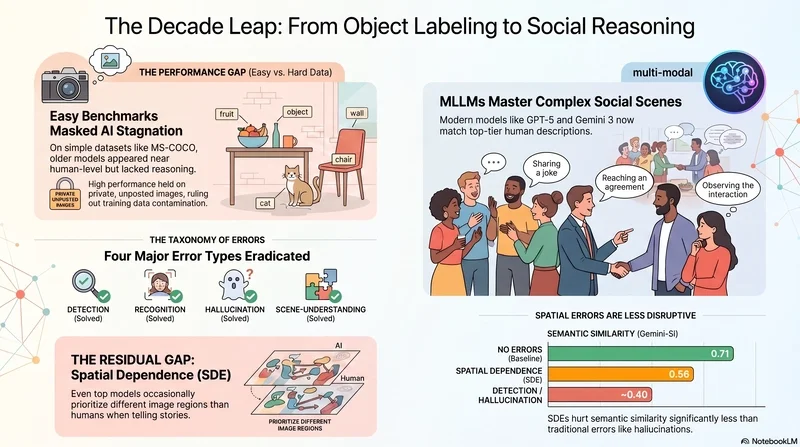
Vision-language models have claimed human-level performance in scene description, primarily using easy benchmarks like MS-COCO. These benchmarks feature simple scenes and are not representative of complex real-world interactions. Previous evaluations often relied on metrics that inflated perceived progress by rewarding superficial word overlap. A significant gap existed in understanding which specific visual-cognitive errors models still commit.To address this, researchers created a new dataset, Complex Social Behavior (CSB), comprising 100 challenging movie frames requiring social reasoning. They also developed a more reliable semantic similarity metric, correlating better with human judgment than existing scores. Nine models, from older captioners to modern multimodal large language models (MLLMs), were evaluated on both MS-COCO and CSB. A five-way error taxonomy—detection, recognition, hallucination, scene understanding, and spatial dependence—was used to analyze model failures.The results showed that while pre-MLLMs performed poorly on CSB, MLLMs achieved human-level performance on this complex dataset. MLLMs largely eliminated detection, recognition, hallucination, and scene understanding errors on both datasets. The primary remaining systematic failure for MLLMs is spatial dependence, where models focus on different image regions than humans. This error is less detrimental to overall description quality than the others.This study suggests that the field has moved beyond basic object recognition challenges to more nuanced understanding of relational reasoning. The methodology, including ranked human descriptions and semantic similarity metrics, provides a more robust evaluation framework. The findings are crucial for applications requiring interpretation of human behavior, offering quantitative evidence of MLLM capabilities and a diagnostic language for future model development. However, limitations include a small sample size and potential biases from cinematic content. Future work may focus on embodied and 3-D-aware architectures to further improve spatial understanding.