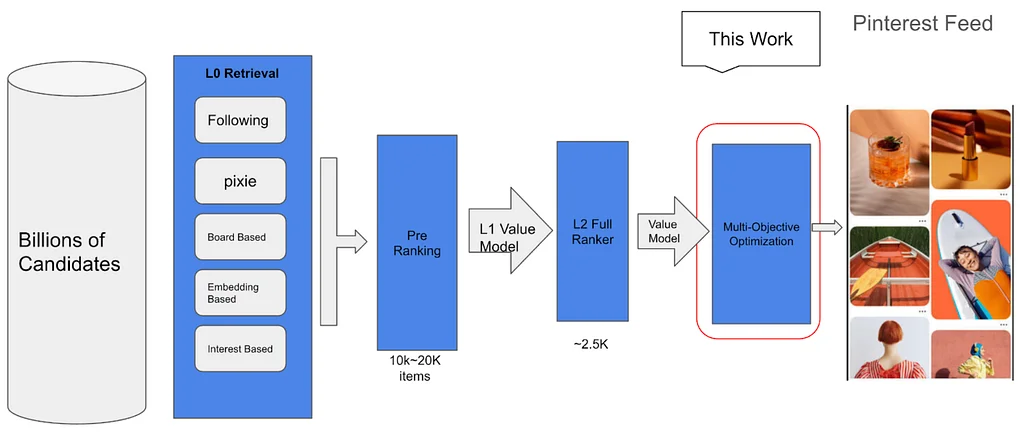
Evolution of Multi-Objective Optimization at Pinterest Home feed
Pinterest's feed recommendation uses a cascaded system for item selection and presentation. The final stage focuses on multi-objective optimization, balancing engagement, new use case adoption, and business goals. The team improved this stage through algorithmic and infrastructure upgrades over time. They initially used a Determinantal Point Process (DPP) algorithm for feed diversification, showing significant user engagement improvements. They later implemented Sliding Spectrum Decomposition (SSD), offering lower computational complexity and flexibility. SSD enabled incorporating quality goals, leading to a "soft spacing" penalty for content requiring extra caution. This framework avoids restrictive filtering, creating a better user experience. The system infrastructure evolved, moving logic to a model server for easier experimentation. Diversity signals have also improved, incorporating visual, text, and graph embeddings for better pin similarity computations. They introduced content quality signals and upgraded visual embeddings for real-time improvements. Semantic IDs were then added to manage semantic overlap for more effective diversity control.