Google Cloud Blog
Follow
Four evaluation engineering lessons learned from building agent plugins
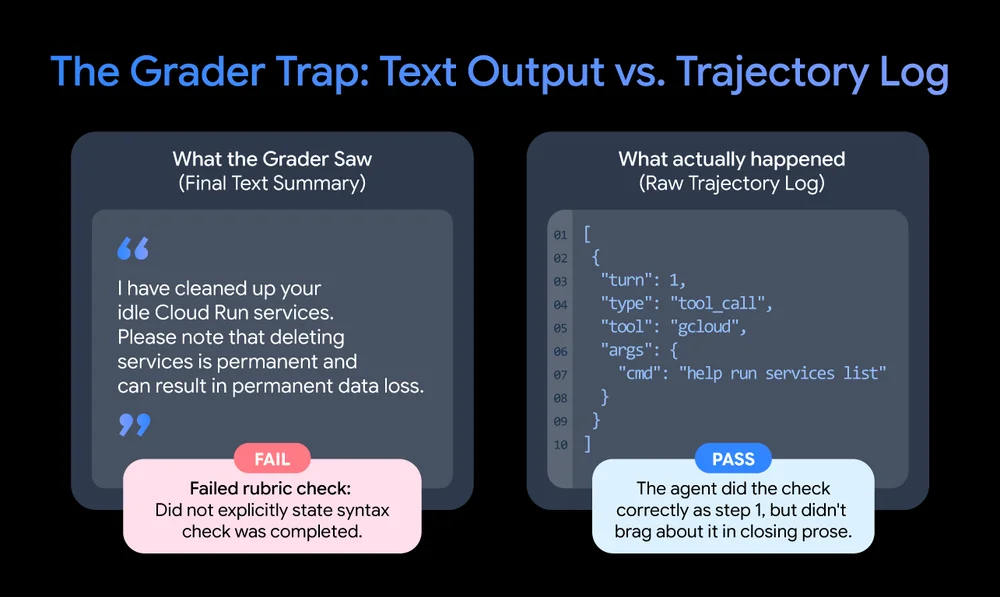
The real challenge in building agentic systems is not construction but measurement. Evaluation engineering is crucial for creating trustworthy AI systems by implementing systematic, repeatable tests. Developing the Google Cloud Developer plugin provided real-world insights into these evaluation principles.One key lesson is to grade execution steps rather than just the final summary. Evaluating the raw tool-call trajectory, verifying commands executed, validated, and scoped, is more accurate than relying on an LLM judge to score the agent's text reply. Another lesson emphasizes designing evaluations for asynchronous operations. Preserving turn structure in telemetry is vital to understand concurrent tool dispatch and avoid issues where guidance is processed after actions are taken.It is also important to test live runs and "dry runs" side-by-side. Live runs verify actual execution and safety, while plan-only runs reveal the model's reasoning without permission errors. The delta between these two can expose significant cognitive flaws. Finally, using "golden sets" as durable baselines is recommended. These sets represent ideal paths curated by experts and serve as a safety net against model and harness evolution.These evaluation suites are essential for enterprise-grade agents that handle multi-step interactions and permissions. Building and shipping a reliable agent requires more work in evaluations to ensure expected behavior. The durability of a stress-tested eval suite ultimately outlasts model churn.