Google Cloud Blog
Follow
Global AI routing with <1% overhead on multi-cluster GKE Inference Gateway
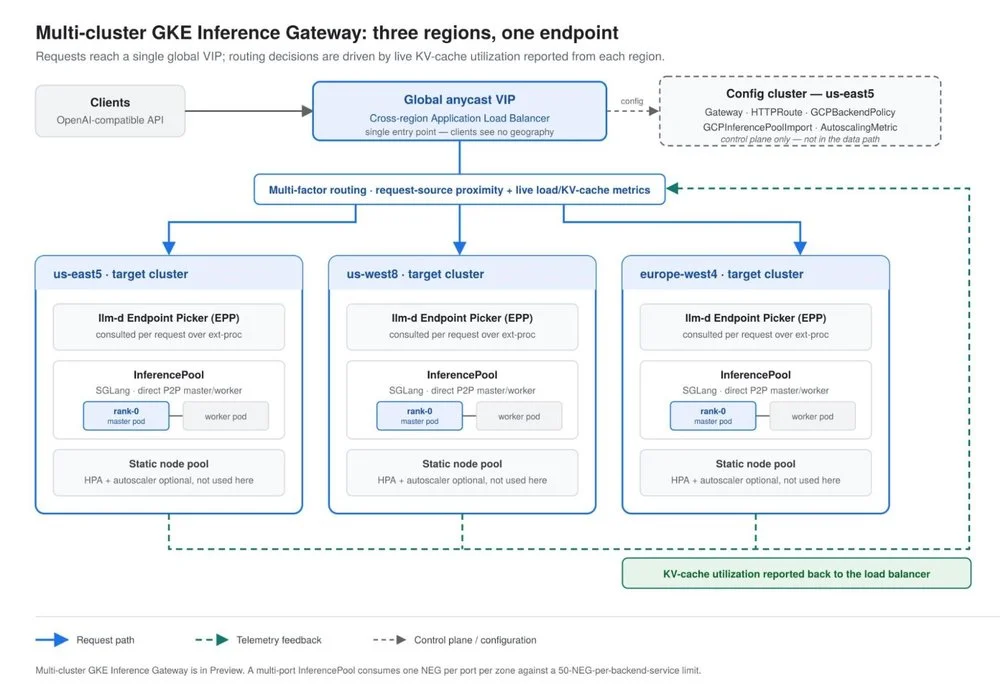
The demand for AI infrastructure, particularly accelerators, is extremely high, leading to shortages and fragmented compute capacity across global data centers. Modern AI workloads, with large context windows, consume accelerator memory rapidly, exacerbating utilization issues. To address this, a layered routing architecture was developed to treat globally scattered capacity as a single pool. This system features a multi-cluster GKE Inference Gateway for global traffic distribution and an LLM-d router for memory-aware scheduling. The architecture is designed to be agnostic to runtime, model, and accelerator types. Benchmarks on a large multi-region GKE deployment demonstrated near-linear throughput scaling and a 99.9% success rate. The GKE Inference Gateway added less than 1% overhead, delivering 99.5% of direct cluster call throughput. Traffic is routed based on live application signals, specifically KV-cache token utilization, enabling the system to intelligently spill traffic between regions. This memory-aware routing ensures efficient utilization by preventing accelerators from being stranded due to memory saturation. The payoff is maximized "intelligence per dollar" by achieving near-proportional performance gains from added accelerators and avoiding wasted capital. Key lessons emphasize the importance of smart load balancing, considering agentic workload memory bottlenecks, adapting to AI traffic latency, integrating routing with native serving patterns, and opting for open, portable stacks.