Google Cloud Blog
Follow
Grounding agents in one context graph connecting semantic models you already trust
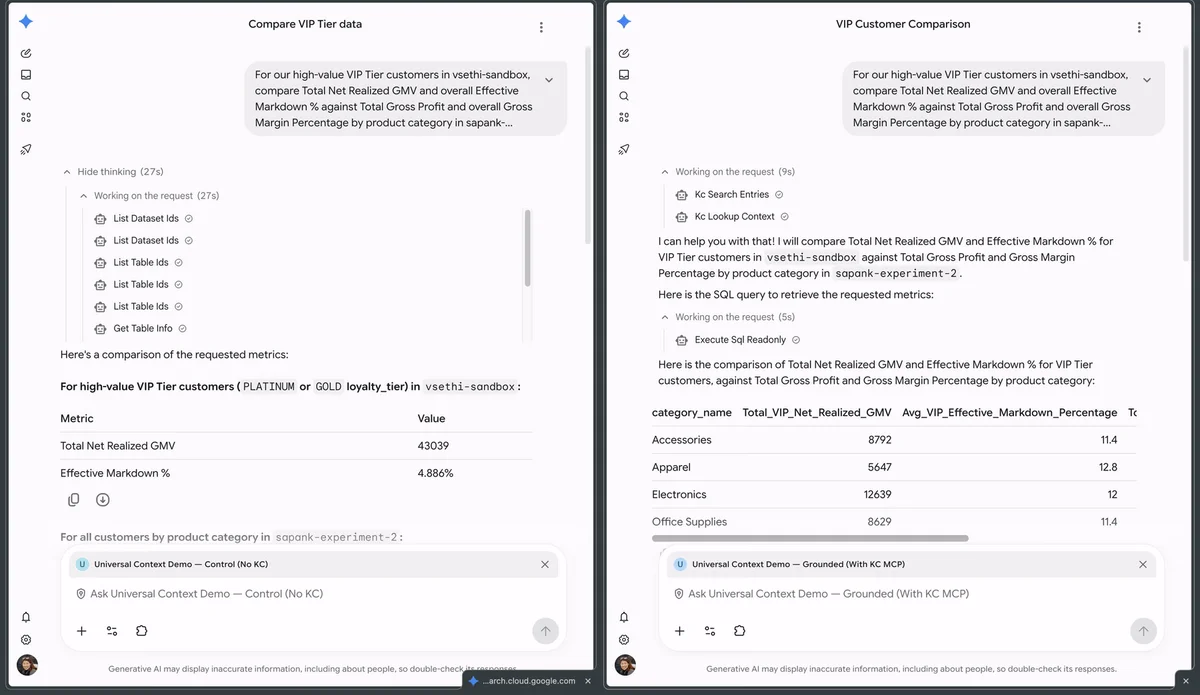
AI agents often fail to answer business questions accurately due to a lack of understanding of business-specific definitions, a problem compounded by scattered semantic models. Knowledge Catalog addresses this by unifying semantic models from various tools into a single context graph. This allows AI agents to access consistent, validated definitions, improving accuracy significantly. The platform now supports native ingestion of semantic models from Looker, BigQuery, dbt, Snowflake, Databricks, and SAP. This integration ensures agents use the same business logic as human analysts, leading to more reliable answers.Grounding agents in Knowledge Catalog results in nearly 4X greater accuracy, up to 33% lower latency, and up to 75% fewer tokens used. The unified context graph reuses existing semantic models and enhances them with self-learned context from unstructured sources. It also pairs business logic with enterprise trust by linking definitions to data quality scores and freshness signals. The context graph maps the entire data estate, including tables, semantic models, and glossary terms, with lineage and join paths. Each source, like Looker LookML or dbt MetricFlow, adds its unique perspective to the graph. Overlapping definitions are preserved and labeled, empowering data stewards to reconcile conflicts. All of this can be explored and governed in Knowledge Studio, which allows users to curate context sets for various use cases. Ultimately, Knowledge Catalog enables AI agents to provide trusted, accurate business insights by leveraging a comprehensive understanding of an organization's data.