Google Cloud Blog
Follow
How to modernize Apache Hive using Google Cloud’s Lakehouse runtime catalog
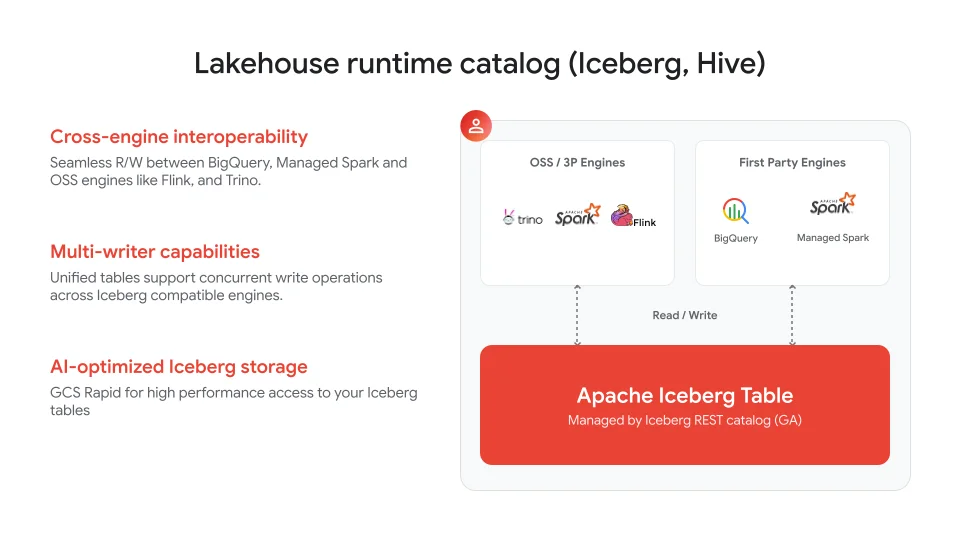
For over a decade, Apache Hive Metastore (HMS) has been the central authority for big data analytics, managing schemas for query engines like Spark and Presto. However, as data architectures scale and span multiple query engines, legacy HMS deployments become significant operational bottlenecks. These legacy systems struggle with architectural scaling issues, as their reliance on relational databases creates performance issues. They also create siloed identity and security governance, requiring fragmented policies across different control planes. Furthermore, managing and tuning standalone HMS instances leads to considerable operational overhead and increased total cost of ownership.Google Cloud's serverless Lakehouse runtime catalog offers a solution, built on the open Apache Iceberg REST Catalog specification. This catalog is a unified, highly available metadata registry supporting both legacy Hive/Parquet and modern formats like Iceberg. It decouples metadata discovery from compute engines, allowing multiple engines to access data without copying. This enables multi-engine interoperability, open APIs, and zero-data-copy migrations by directly referencing existing data in cloud storage. AI-powered governance integrates with Cloud IAM for consistent security and trusted context, and credential vending further enhances security.The Lakehouse runtime catalog is enterprise-ready, scaling on Google's infrastructure and offering high availability for failover. Its serverless nature reduces operational toil and total cost of ownership. A zero-copy migration capability allows direct transition from legacy Hive Metastores to the Lakehouse catalog. Modernizing to the Lakehouse unifies governance, provides trusted context for agents, and slashes operational costs, preparing cloud environments for agent-scale operations.