Flamehaven-TOE is a physics verification pipeline for string theory, converting hypotheses into tensors and running failure channels to detect inconsistencies. The system, built because no open-source alternative existed, currently has 700 passing tests. Gemini's value was in bridging physics equations and Python code for debugging. The core focus is on verifying, not generating, physical models.
Schrödinger's cat analogy illustrates the need for verification in the string landscape, where numerous configurations exist in superposition until measured. The pipeline acts as a measurement tool, categorizing configurations as PASS or FAIL based on physical constraints (BETA, BRST, PDE). The pipeline has several modules that use physics agents to assess string background fields. Testing validates against published solutions, with layer 2 cross-validation confirming results.
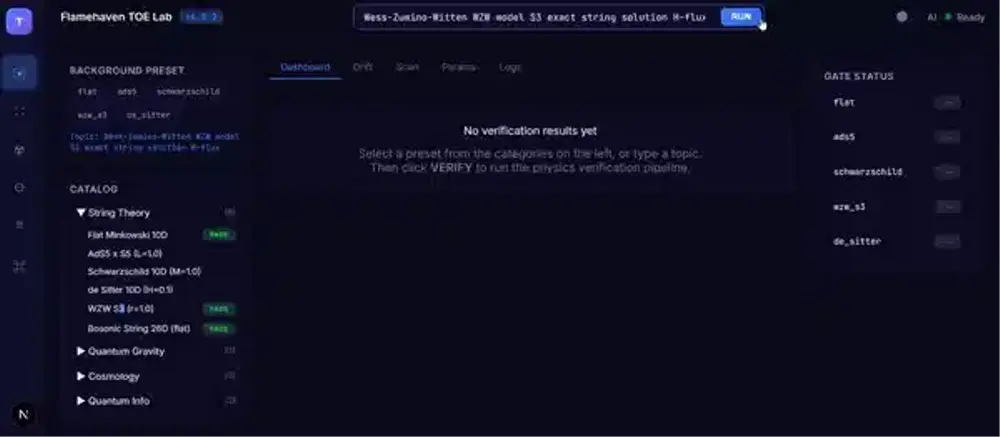
Live results demonstrate the pipeline's ability to identify both consistent (WZW S^3 model) and inconsistent (linear dilaton, D=4) scenarios. The WZW S^3 test highlights the importance of the pipeline's ability to verify global properties, a task beyond the reach of RAG systems alone. The pipeline found that the physics core files are the cleanest in the codebase.
Gemini's primary function was translating formulas into code, particularly for complex transformations like T-duality, while maintaining algebraic integrity. The project's development paralleled Gemini's model upgrades, starting with module creation and evolving towards simultaneous, multi-step tensor derivations. The latest version, Gemini 3.1 Pro, enabled deeper reasoning and gate differentiation, improving analysis and verification accuracy.

dev.to
dev.to

RSS Hunter
2026-03-04
Create attached notes ...