Google Cloud Blog
Follow
Infrastructure for the AI era: Dynamic capacity management for agents
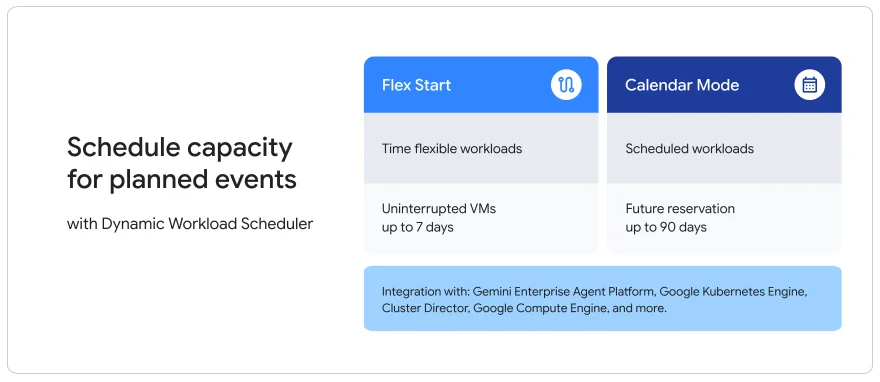
The internet's expansion and mobile devices have paved the way for a new era of autonomous AI agents working alongside humans. Managing the cost and infrastructure demands of these AI workloads is critical due to their resource-intensive and bursty nature, leading to potential underutilization. Organizations need dynamic capacity management strategies to optimize infrastructure investments, ensuring predictable cost and performance for both enterprise and AI applications. This involves securing resources for predictable demand and automating responses to unforeseen changes.One key strategy is scheduling capacity for planned events using Dynamic Workload Scheduler. This offers "flex-start mode" for cost-optimization of latency-tolerant batch jobs and "calendar mode" for guaranteed capacity during mission-critical, time-bound events. Another crucial aspect is maintaining service continuity through fallback plans for every application. This involves defining automated, prioritized hardware fallback lists using managed instance groups (MIGs) for non-containerized workloads on Google Compute Engine, allowing applications to automatically pivot to alternative compute options.For containerized workloads, Google Kubernetes Engine (GKE) provides an adaptive control plane to automate the entire capacity management lifecycle. GKE's custom ComputeClasses enable the design of multi-dimensional fallback lists, dynamically combining different VM families, sizes, and scaling across zones and consumption models. GKE also offers dynamic resource allocation, allowing applications to define exact hardware parameters, thereby maximizing utilization and reducing costs by allocating only the necessary "slice" of hardware instead of an entire GPU or TPU.Overcoming infrastructure constraints requires a two-pronged approach: securing resources for predictable demand and building automation for unpredictable demand. This combined strategy ensures prescheduled capacity for planned events while allowing the infrastructure to adapt to unexpected changes without manual intervention. Architectural flexibility is paramount as 90% of enterprises plan to deploy agents, but only 17% are confident in their current IT setup. This necessitates not just specialized infrastructure, but also intelligent utilization strategies to solve execution inefficiencies.To begin implementing dynamic infrastructure, organizations should audit their workloads for immediate cost savings, identifying applications tightly coupled to single VM families or zones and mapping out viable alternative hardware shapes. Committing to a minimum spend can also unlock deeply discounted prices through committed use discounts. Finally, engaging with their Google Cloud account team is recommended to craft a tailored capacity management strategy and configure automated fallback lists.