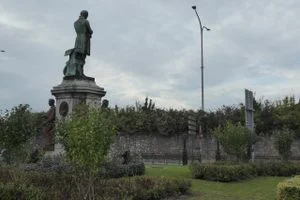
John Cockerill's Tomb in Seraing, Belgium
Seraing, a town southwest of Liège on the Meuse, is synonymous with industry, famous for its Cristallerie du Val-Saint-Lambert and the historic Cockerill steelworks. Founded in 1817 by British industrialist John Cockerill, these factories cemented Liège as the continental pioneer of the Industrial Revolution. Cockerill diversified production at the Château de Seraing, introducing the first coke blast furnace in 1821 and transforming his enterprise into a leading steelmaker. By the mid-19th century, his industry's success elevated Belgium to the world's second-largest industrial power.
John Cockerill died in 1840, and his body was interred in Seraing in 1867, prompting the creation of a public monument unveiled in 1871. This monument features Cockerill on a pedestal, flanked by four worker sculptures representing key factory trades. His remains were finally laid to rest in a crypt before the monument in 1947.
However, a darker history underpins this homage: a column near the monument details flood dates, revealing Seraing’s center lies permanently below the Meuse. John Cockerill's extensive coal mining for his factories inadvertently caused the ground level to sink, making frequent flooding a recurring issue. Despite constructing a protective wall and initiating the "Démergement" project to pump water back into the river, these efforts proved insufficient.
In 1925, a hundred-year flood breached the wall, devastating the city center. Today, Seraing’s survival depends on continuous pumping, as stopping them would lead to rapid inundation. Ironically, Cockerill's tomb, along with the city, is now vulnerable to the very river whose resources he exploited. His statue perpetually faces the high wall separating the city from the Meuse, a stark symbol of the broken link between the town and its riverine past.