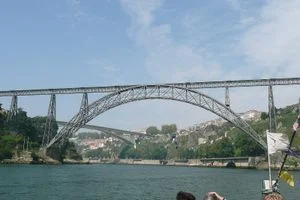
Maria Pía Bridge in Vila Nova de Gaia, Portugal
Porto is a city where history and industry merge, offering a unique charm to visitors. Travelers are drawn to its port wine, fado music, and riverfront views, but its deeper appeal lies in its interwoven past and present. A prime example of this union is the Maria Pia Bridge, an iron masterpiece by Gustave Eiffel. Designed before his more famous Eiffel Tower, the bridge was completed in 1877, showcasing Eiffel's innovative engineering. Working with Théophile Seyrig, Eiffel created a graceful, lightweight wrought-iron arch spanning the Douro River. This ambitious project demonstrated the daring structural concepts that would later characterize his Parisian monument. Named for Queen Maria Pia of Savoy, the bridge connected Porto and Vila Nova de Gaia, revolutionizing rail transport. Its central arch was the world's longest iron arch span at the time, measuring 160 meters. Despite its impressive strength, the bridge's delicate iron lattice gives it an almost fragile appearance. Although no longer used for rail traffic, the Maria Pia Bridge remains a prominent industrial landmark in Porto. It continues to captivate with its elegant silhouette and improbable balance over the water, symbolizing an optimistic era of iron and ambition.