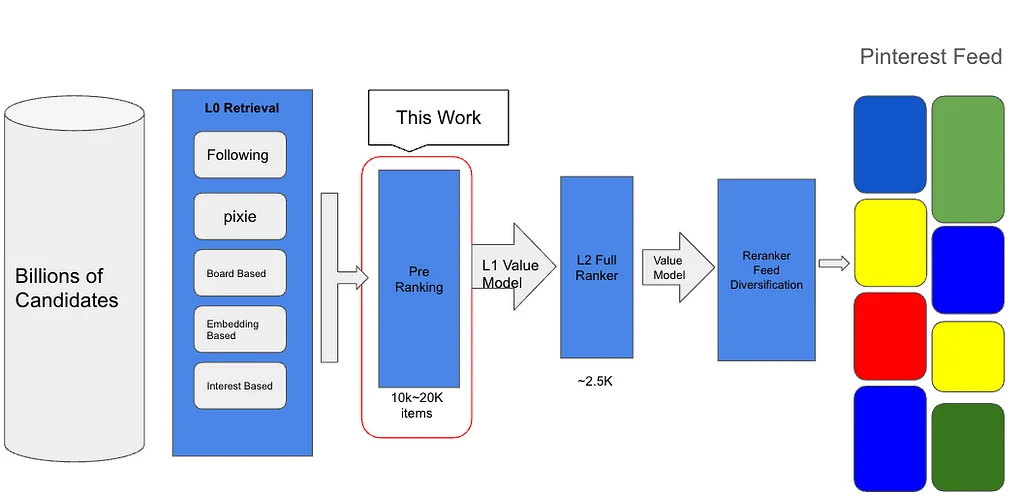
Modernizing Home Feed Pre-Ranking Stage
Pinterest's home feed recommendation system has adopted a multi-stage design, and the team has achieved a significant milestone with a sophisticated pre-ranking layer that improved business metrics. The initial design had limitations, including deployment efforts, model auto-retraining challenges, and a two-tower architecture that couldn't learn item interactions effectively. The team has made foundational improvements to modernize the pre-ranking layer, including a new system design, logging pipeline, and serving architecture. The new design includes a request-level sub-component and an item-level sub-component that are jointly trained and decoupled during serving. The team has also implemented an early funnel logging pipeline to distinguish pre-ranking from ranking and to bring unbiased data into training. The serving architecture design includes a root-leaf architecture to mitigate CPU and memory overhead. The team has also adopted model distillation to better align the pre-ranking model with the L2 ranker. Online experiments have shown significant engagement wins, and the team has also worked on setting up an auto-retraining framework to leverage fresh engagement data. The team is continuing to work on modeling innovations, data sampling, model architecture improvement, loss exploration, and serving optimization.