Module Relevance on Homefeed
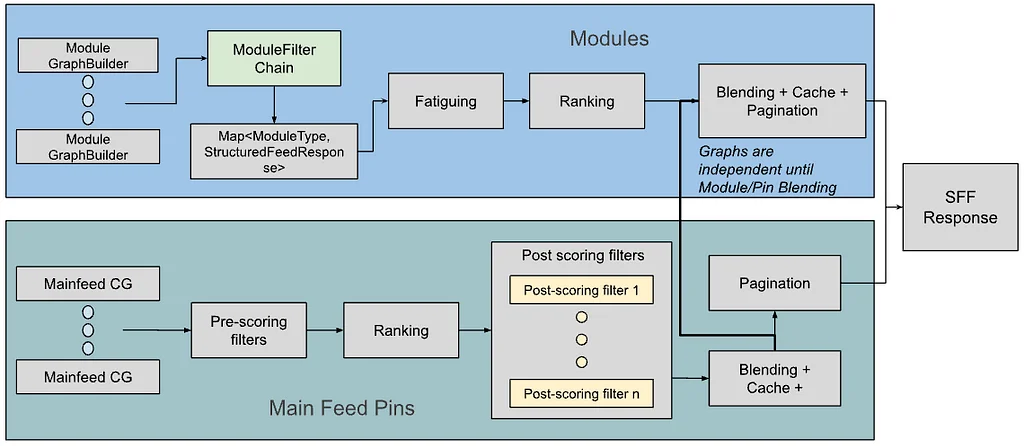
Pinterest introduced modules to the Homefeed to provide users with more context and ways to explore topics. Modules are heterogeneous, with variations in UI and content based on factors like topics, boards, and shopping interests. There are two types of modules: landing page modules and carousel modules. To optimize the Homefeed experience, the Module Relevance Platform was developed to dynamically blend modules and Pins.The platform includes several components, such as module fatiguing, module ranking, and module blending. Module fatiguing was initially used to hide modules that users had seen multiple times without interacting with them. However, this approach had limitations, including not informing how or where to show a module within a feed and not being real-time responsive.To address these limitations, a module ranking model was developed to rank modules amongst each other. The model uses a comprehensive feature set of modules and users, including aggregated features, module title embeddings, and user engagement features. The model is trained on user engagement data and optimizes for module actions such as taps, clicks, and saves.Module blending decides how to dynamically blend modules and Pins together to generate the feed. The initial approach placed ordered modules in static fixed slots, but this was replaced with a 'skip slot' approach that dynamically blends Pins and Modules based on predicted engagement. The approach uses a comparison function to determine whether a module should replace a Pin based on their predicted engagement scores.The Module Relevance Platform has been rolled out in production, and real-time monitoring metrics have been developed to monitor its health. Future plans include iterating on the components to further improve relevance using magnitude-based ranking and blending, and Pin displacement-based blending.