Google Cloud Blog
Follow
New capabilities to power agents at scale with Google's Agentic Data Cloud
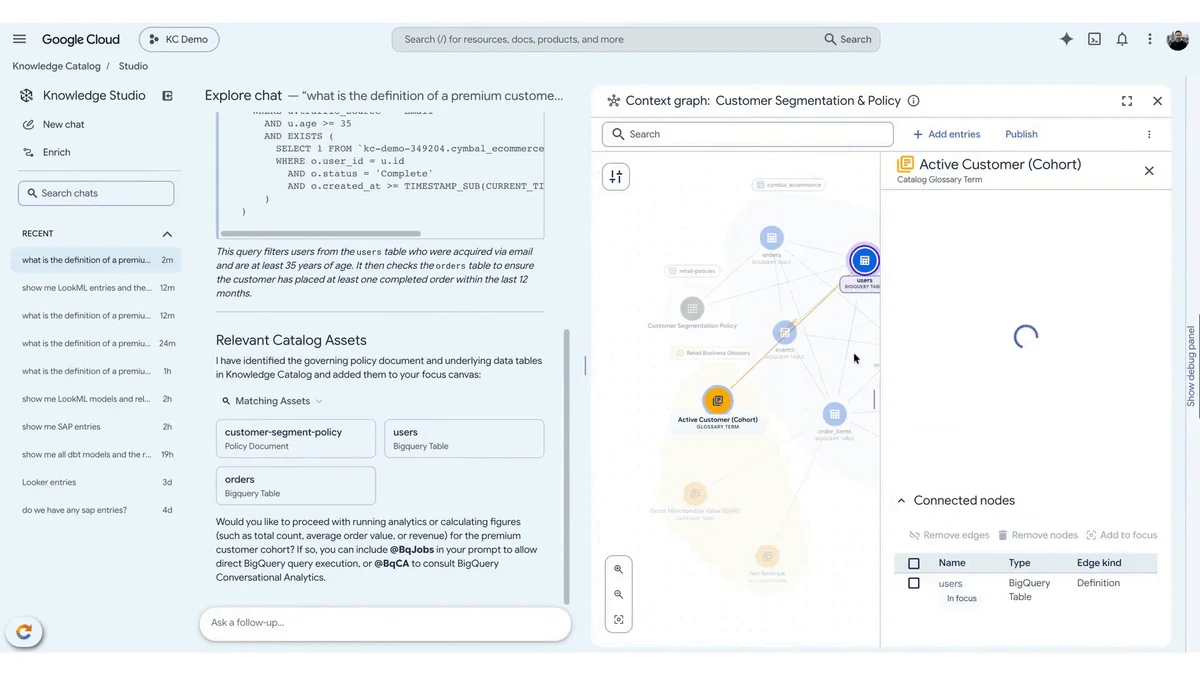
Organizations are increasingly leveraging agent-driven automation to enhance revenue, efficiency, and risk management. Google’s Agentic Data Cloud is a System of Action designed to unify enterprise data, ensure accuracy, and operate proactively at low cost. The borderless Lakehouse activates distributed data across multi-cloud, on-premises, and SaaS platforms using open Apache Iceberg format. New enhancements allow Gemini to query the Lakehouse with natural language, and cross-cloud interconnect provides secure, zero-egress fee data access. AlloyDB integration enables agents to query Iceberg tables directly, joining historical and real-time data efficiently. Spanner Omni extends Google-grade consistency and scale for hybrid agentic applications. Knowledge Catalog, Google Cloud’s universal context engine, grounds agents in enterprise context, improving accuracy, reducing latency, and lowering token costs. Self-learning enrichment and reusable OKF context sets automate context curation from unstructured sources like Google Workspace and SharePoint. A new studio experience in Knowledge Catalog offers a conversational UI for exploring and governing context. Knowledge Catalog is now default in Gemini, grounding data questions in governed business context and supporting trusted semantic models from various platforms. Google is transforming practitioner experiences, enabling data and ML engineers to orchestrate agents for intent-driven outcomes with Gemini’s machine learning skills. Business users can generate real-time operational reports by simply asking. The Data Agent Kit integrates Google Data Cloud tools into developers' preferred IDEs and CLIs. Google is also engineering data infrastructure for agent scale, introducing AlloyDB Express for rapid prototyping and PostgreSQL for agents in AlloyDB for production. Managed Service for Apache Spark extends price-performance, and BigQuery is enhanced with faster queries, BigQuery Graph for petabyte-scale graph analytics, and new Google Research models like TimesFM 3.0 and TabFM.