Google Cloud Blog
Follow
Not All LLM Workloads Are Equal: Benchmarking TPU Performance on Classification vs. Generation
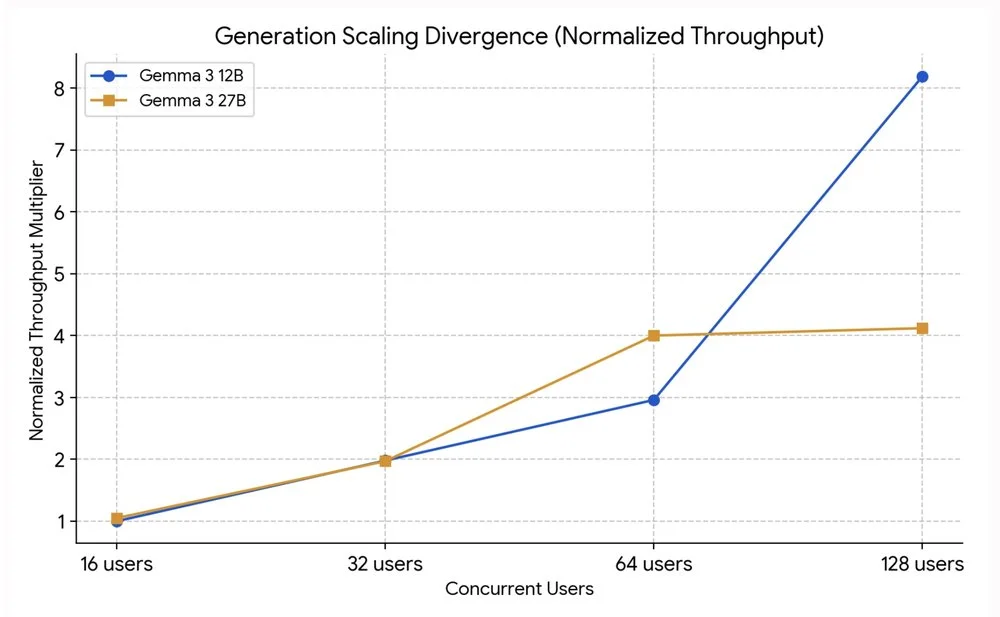
Enterprise production deployment of LLMs reveals infrastructure's critical role in performance and cost. Not all LLM requests stress hardware equally, making standard benchmarks insufficient. This study compares Gemma 3 12B and 27B on Google Cloud TPU v6e to understand infrastructure performance at scale with distinct workloads. For decode-heavy generation, the Gemma 3 12B model scales better at high concurrency, unlike the 27B model which saturates. For prefill-heavy classification tasks, both 12B and 27B models show similar scaling, allowing larger models without a throughput penalty. Hardware saturation causes latency spikes and silent request drops, necessitating scaling based on End-to-End latency, not just CPU/memory. The architecture comprises GKE, TPU v6e, vLLM serving framework, and Gemma 3 models. Classification tasks have high input and low output, while generation tasks have low/medium input and high output. Benchmarks show the 12B model's superiority in generation scaling at high concurrency, whereas both models perform similarly in classification. To optimize, align model selection and serving configurations with specific workload input/output profiles.