DEV Community
Follow
Nothing throws when redaction fails
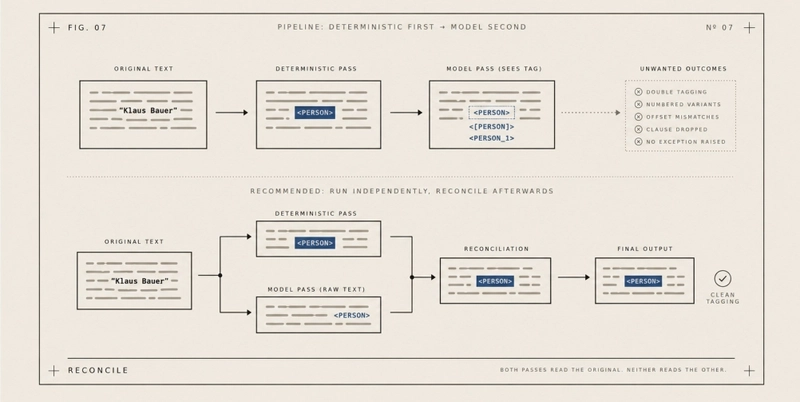
Redacting PII effectively requires careful pipeline design, as models often fail silently. Initializing with a rule-based pass before involving a model can worsen outcomes by creating unnatural token patterns that confuse the model. Instead, run both semantic and structural passes independently on the original text, then reconcile the results, ensuring structural offsets remain valid and filtering out low-confidence date detections from the structural pass.Markup in enterprise documents can garble model outputs; extract plain text, redact, and then re-insert into the original structure to improve recall significantly. Implement refusal detection for models that decline redaction, falling back to structural passes and logging these instances to inform prompt adjustments.Crucially, design the system to "fail closed" rather than "fail open" to prevent data leaks when redaction calls time out, treating structural passes as a degraded path and alerting on such events. Version control prompts by logging model ID and prompt hash with every redaction to track performance changes over time.For co-reference in redacted text, use numbered placeholders instead of generic tags, but be aware that the resulting mapping table is also PII and requires appropriate security, or discard if reversibility is not needed. To measure precision, create a canary set of PII-free documents and run it with every change; any redactions in this set signal regressions.When scaling, move beyond a single model by building a routing interface that directs requests to different models based on caller constraints like latency, residency, or language, with the structural pass always serving as a universal fallback. Implement careful caching strategies for prompts longer than 1,024 tokens to optimize cost and throughput. The recommended build order involves extracting text, running independent semantic and structural passes, filtering dates, injecting structural findings, substituting back into markup, detecting refusals, and logging essential metadata, all while continuously testing with a canary set.