UX Collective | Medium
Follow
OKLCH with ChatGPT-5
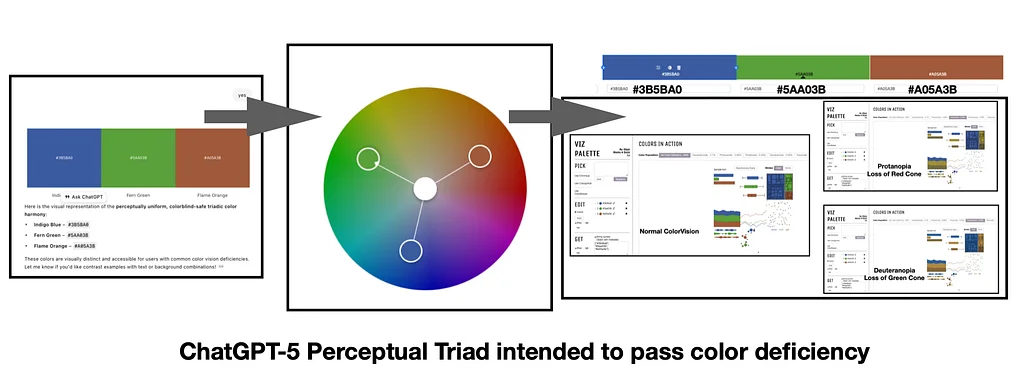
The author explored ChatGPT-5's ability to suggest a perceptually uniform triad color harmony that is also accessible to individuals with color deficiencies. Color harmony, based on color wheels, aims for aesthetically pleasing combinations. Traditional color spaces like RYB and RGB are not perceptually uniform, meaning color changes don't appear uniform to the human eye. Perceptually uniform color spaces, such as Oklab and Oklch, aim to correct this, which is crucial for data visualization to avoid misinterpreting color transitions as data changes. Color deficiencies occur when one or more types of cone cells in the eye malfunction, affecting color perception. Previous attempts, like with Claude, struggled to find a triad that met both perceptual uniformity and color deficiency requirements. ChatGPT-5 provided a solution using the Oklch color space, suggesting Indigo Blue (#3B5BA0), Fern Green (#5AA03B), and Flame Orange (#A05A3B). This triad was verified to map correctly on traditional color wheels and remain distinguishable for common color deficiencies. The author further tested these colors using the Viz Palette tool for data visualization applications. The results indicate that ChatGPT-5 successfully generated a universally accessible color triad.