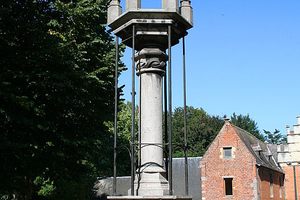
Pillory of Braine-le-Château in Braine-le-Château, Belgium
Braine-le-Château, a town 20 km southeast of Brussels, shares a border with Halle, home to the notable Blue Forest. The town is significantly tied to the Counts of Hornes, especially Maximilien de Hornes (1475-1542), chamberlain to Charles V. He is credited with five listed monuments in the town center, including his recumbent statue in the church, the Horne castle, a water mill, the bailiff's house, and the pillory.
The Braine-le-Château pillory, built in 1521, is on the central square, demonstrating Maximilien's judicial authority. Justice, administration, and taxes were managed by the bailiff, whose house was also on the square, on behalf of Lord Maximilien de Hornes.
The pillory comprises high steps supporting a column, its capital inscribed with "Maximilien de Hornes de Gasbecke, Knight of the Golden Fleece of the Emperor Charles, 1521." It also features a skylight with six columns supporting a small roof, replaced during a 2019 restoration. Under the Ancien Régime, convicts were subjected to public exposure at the pillory’s lantern on market days.
In 1794, during the French Revolution, bailiff Justinien Thienpont successfully argued against the pillory's abolition, asserting its symbolic importance to the town. Although threatened again in 1839, its proposed transformation into a public fountain ensured its preservation. Two stone troughs were added in 1849, though water never flowed.
The pillory officially became a historical monument on December 21, 1936, and is now part of Wallonia's exceptional architectural heritage. The latest restoration in 2019 saw the roof, whose existence was known but unrepresented, restored.