Pinner Progression: Better Use-Case Representation Driving Weekly Active User Growth at Pinterest
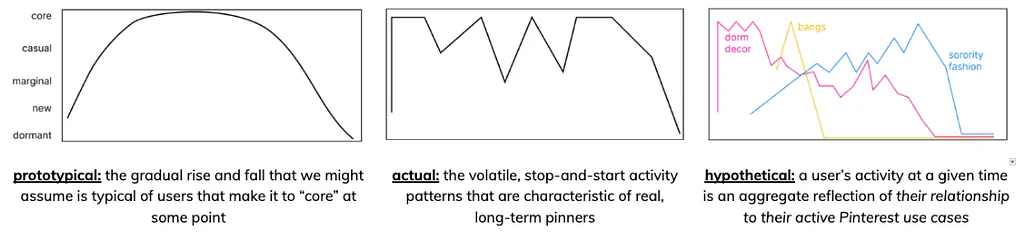
Pinterest aims to help users discover inspiration for a better life through its recommendation system. The home feed, a key discovery platform, utilizes a multi-stage pipeline for recommendations. Previously, optimization focused on engagement metrics like clicks and saves. However, engagement and retention are distinct, and optimizing solely for engagement can lead to user churn.This post introduces Pinner Progression, a program that prioritizes user retention by understanding their evolving needs. The core idea is to combine sequential user understanding with persistent use-case representation. This approach helps anticipate user actions and offer recommendations that foster serendipitous discovery. A key signal introduced is User Interest Clusters (UICs), which represent distinct use-cases users engage with.Sustainable growth relies on building lasting user relationships with specific use-cases, not just short-term engagement. Analysis shows that the adoption of use-cases correlates with sustained engagement and retention. Modern recommendation systems excel at understanding current user preferences but struggle to model the lifecycle of these preferences. Distinguishing between a user's active "apartment decorating" phase and a decaying "sourdough" phase is crucial for long-term retention.UIC representation builds upon past work like PinnerSage and OmniSage. It innovates by personalizing clustering to engaged content only, allowing a dynamic number of clusters per user. Crucially, each UIC includes stateful lifecycle metadata, providing temporal and behavioral insights. This metadata helps infer the maturity of a user's interest, differentiating fleeting curiosity from emerging habits.UICs are defined by medoids and landmark Pins within the OmniSage embedding space, where closeness signifies functional utility. Signal construction involves hierarchical clustering of a user's recent engagement embeddings. The complete linkage algorithm merges clusters based on the similarity of their least similar pairs, with a similarity threshold. This process stops when no remaining pair exceeds the threshold or a maximum cluster count is reached.System-level integration involves using UICs as a shared abstraction across the retrieval, ranking, and blending stages of the recommendation pipeline. This allows different system components to reason about the maturity of a user's interests. UICs are externalized to a shared feature store for efficiency, reducing latency associated with multiple signal fetches. Future work includes extending UICs with long-sequence representations that preserve temporal dynamics.
Retrieval is the first integration point, where Conditional Learned Retrieval generates candidates using user information and conditions to ensure semantic relevance.